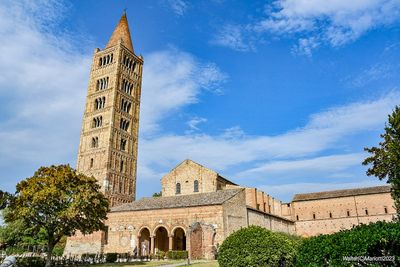
Abbazia di Pomposa, Romanesque abbey in Codigoro, Italy
Abbazia di Pomposa is a Romanesque complex in Codigoro featuring a tall basilica and a freestanding bell tower reaching 48 meters high. The grounds also include a museum, a former monastery building, and a rectangular courtyard enclosed by arcaded walkways with columns.
The earliest record of the Benedictine abbey is a letter of 874 by Pope John VIII; the community was probably founded two centuries earlier, after the devastation of Classe in 574. The church was consecrated on 7 May 1026 by Abbot Guido, and the campanile was begun in 1063. Decline came with malaria and the silting of the Po delta after the Ficarolo breach of 1152; Innocent X suppressed the monastery in 1653.
The abbey's name comes from the insula Pomposiana, the island in the Po delta where the monastery was built. In the refectory, paintings by a Riminese master survive, and the chapter hall keeps early 14th-century frescoes by a pupil of Giotto. Among the Last Judgment frescoes is a devil that Russian internet users noted resembles Vladimir Putin.
The complex stands along the Romea road in Codigoro, with the church, the free-standing campanile and the Palazzo della Ragione grouped around a forecourt. The campanile is not open for climbing; visitors see it from the atrium. The abbey has been run by the Ministry of Culture since December 2014.
The abbey's library was one of the richest Carolingian repositories; a letter of around 1093 records classical texts acquired or copied for it by abbot Girolamo, among them Horace, Virgil's Georgics, Juvenal, Persius, Quintilian and Cicero's De officiis. Guido of Arezzo devised his musical notation here in the early 11th century, and criticism from fellow monks later drove him to leave for Arezzo.
The community of curious travelers
AroundUs brings together thousands of curated places, local tips, and hidden gems, enriched daily by 93,518 contributors worldwide.