Honkō-ji Temple, Head temple of the Hokke-shū Honmon-ryū school in Amagasaki, Japan
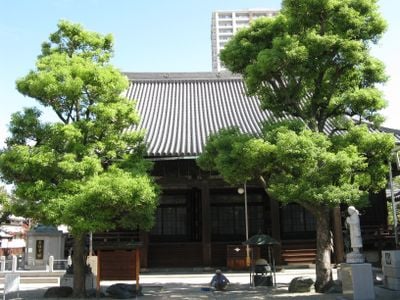
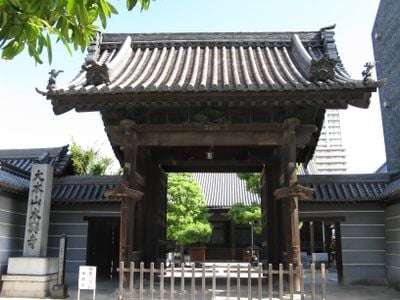
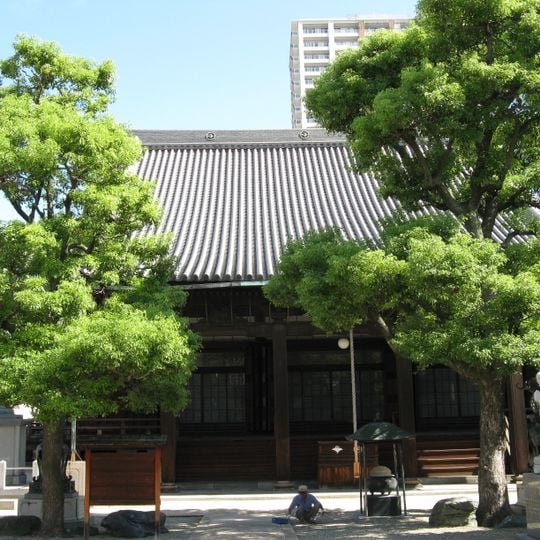
Honkō-ji is the head temple of the Honmon school of the Hokke sect in Amagasaki. Its single-storey main hall has a dark grey tiled roof with round end tiles and a dark wooden lattice facade. A two-storey timber gate with a tiled hipped-and-gabled roof opens onto a paved path. The grounds also hold a three-storey pagoda, a bell tower and the Sanko-do hall.
Nichiryū founded the temple in 1420 at Daimotsu after prayers for the safe birth of Hosokawa Mitsumoto's son; a 1423 completion date is also recorded. In 1454 the Kangaku-in study institute was established, making Honkō-ji the Hokke-shū Honmon-ryū centre of doctrine while Honnō-ji led missionary work. The temple moved to its present site in 1617 when Toda Ujikane built Amagasaki Castle. The main hall burned in 1822 and was rebuilt in 1827.
The temple's name is written on the small white sign by the gate. Its Kangaku-in study institute, founded in 1454, made Honkō-ji the scholarly centre of the Hokke-shū Honmon-ryū school, while Honnō-ji led its missionary work. The institute later became the Hokke Gakuen Kōryū Gakurin vocational school, which returned beside the temple in 1973.
The temple is accessible within a short walk from Amagasaki Station via the Hanshin Main Line and Hanshin Namba Line. The location is convenient and well-connected, situated in a central area with nearby shops and dining options for visitors.
The Juzumaru, a sword counted among Japan's Five Great Swords, was kept at Kuon-ji on Mount Minobu before it left the mountain and its whereabouts became unknown. Around 1919 the Amagasaki sword appraiser Sugihara Shōzō found it, and it was donated to Honkō-ji. Its name comes from the rosary Nichiren is said to have hung on it while using it as a staff.
The community of curious travelers
AroundUs brings together thousands of curated places, local tips, and hidden gems, enriched daily by 93,458 contributors worldwide.