Hinumanai Shrine, Shinto shrine in Kyoto Prefecture, Japan
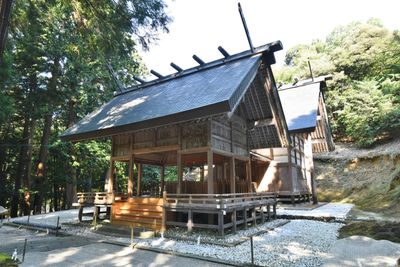
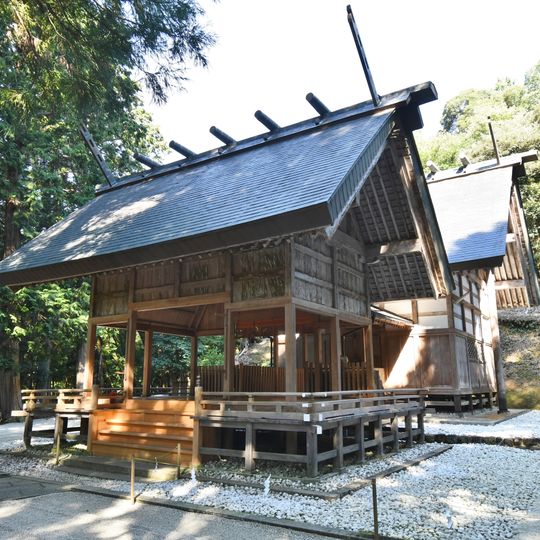
Hinumanai-jinja is a Shinto shrine in Kyotango whose honden is built in the shinmei style, with a broad gabled roof of dark, closely ridged material, cylindrical logs projecting from the ridge and forked finials at each end. The open facade has thick square posts framing pale woven reed panels, a low railing around the deck and a short wooden stair at the front left. A smaller roofed wooden structure stands behind to the right, among gravel and trees.
The shrine is believed to be over 1000 years old and was originally part of a system connected to the grand shrines of Ise. It served local farmers and villagers as a place to pray for good harvests, health, and protection, a tradition that continues to this day.
The name Hinumanai derives from Kushihi no Manai: the 'hi' of Kushihi was dropped, 'Manai' was written with the characters 麻奈為, and the connecting particle 'no' was written as 沼, pronounced 'nu' in ancient Japanese. The shrine's annual festival on 15 September features a sword dance, kagura, and sasa-bayashi, a bamboo-flute performance said to reenact the myth of Ame-no-Uzume before the heavenly rock cave.
The shrine stands at 510 Miyadani, Kuzu, Mineyama-chō, Kyōtango, on the slope of Kuzu-dake. From Kyōtango Railway's Mineyama Station take the Tankai bus toward Kumihama and get off at Nika; the shrine is a 20-minute walk from there. The precinct covers 1,799 tsubo, most of it government land in the Meiji period.
The shrine's name compresses a phonetic history: Kushihi became Kushi, then Hisagi, and the no connecting particle was written with the character for swamp, nu, a pronunciation the source calls an ancient trait. The main hall is a one-bay structure built in 1922, though an 1884 ridge tag records a three-bay, three-shaku plan.
The community of curious travelers
AroundUs brings together thousands of curated places, local tips, and hidden gems, enriched daily by 93,451 contributors worldwide.