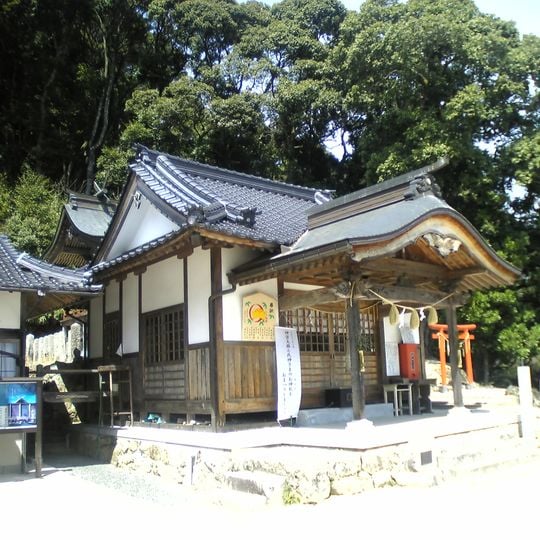
Isonokamifutsumitama Shrine, Shinto shrine in Okayama Prefecture, Japan
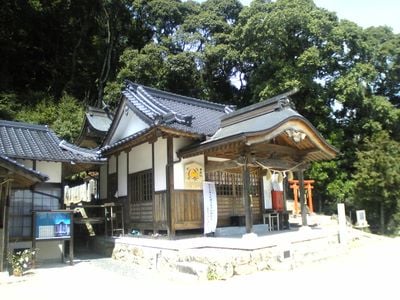
Isonokamifutsumitama Shrine stands on the mountainside in Akaiwa, Okayama Prefecture. Its wooden worship hall has a steep dark-tiled gabled roof that sweeps forward into a curved eave over the porch, supported by four wooden pillars. The facade mixes white plaster panels with vertical dark wood boarding and a large lattice window; round straw ornaments, a white paper streamer and a vertical banner with black Japanese text hang from the porch, above a small offering box and steps on a stone foundation.
The shrine began by enshrining the sword Futsu-no-mitama, said to have been used by Susanoo to cut the eight-headed serpent; by the Nara period it was listed as a minor shrine in the Engishiki. In the Nara period the sword was moved to Isonokami Shrine in Yamato, as that shrine's own tradition records. In 1669 the Okayama lord Ikeda Mitsumasa rebuilt a small shrine on the summit; in 1915 the hall was rebuilt at its present mid-slope site after a 1907 fire.
The name of the shrine refers to a deity associated with swords and spiritual power, which is reflected in the offerings and ritual objects displayed within the shrine grounds. Visitors can observe local worshippers taking part in seasonal ceremonies that follow long-standing Shinto customs.
The shrine is located in Akaiwa and is most easily reached by car or local bus, as public transport options in the area are limited. Comfortable footwear is a good idea since the grounds have stone paths and some uneven surfaces.
The shrine's upper sanctuary on the mountain was designated an Akaiwa City historic site on 18 February 1984, when the area was still part of former Yoshii Town. The main hall now stands halfway up the slope, rebuilt in 1915 after a major fire destroyed the summit building in 1907.
The community of curious travelers
AroundUs brings together thousands of curated places, local tips, and hidden gems, enriched daily by 93,652 contributors worldwide.