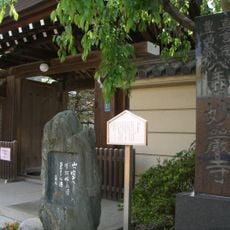
Tateishi-sama, Sacred boulder in Tateishi, Tokyo, Japan.
Tateishi-sama is a sacred stone now standing only a few centimetres above the ground, enshrined at the centre of a small hokora shrine attached to a children's playground in Tateishi 8-chome, Katsushika, Tokyo. The stone is a type of tuff called Boshu-ishi, thought to have been brought from around Mount Nokogiri in Chiba Prefecture, the same material used in the stone chambers of nearby kofun.
The stone is thought to have been brought from around Mount Nokogiri in Chiba Prefecture, since it is made of Boshu-ishi, a tuff, like the stone chambers of the kofun once found nearby. In the Nara and Heian periods it is believed to have been reused as a milestone on the ancient Tokaido official road that crossed this area. In the Edo period it stood over 60 cm tall and, because digging never reached its base, was called the "rooted stone" and appeared in works such as the Edo Meisho Zue. In 1811 it was enshrined as Tateishi Inari Daimyojin, and a torii was donated in 1815.
The stone is worshipped as Tateishi Inari Daimyojin, a shrine title given in 1811, and a torii gate was donated in 1815. A legend holds that the stone shrinks in cold weather and returns to its size when it warms. People also believed that carrying a fragment of the stone cured illness.
The stone stands in a small shrine within a children's playground at Tateishi 8-37-17, about a nine-minute walk from Aoto Station. Only a few centimetres of the boulder rise above ground, so look at the base of the little shelter rather than expecting a tall monolith. The playground is in use by local children; keep voices low and do not climb on the stone.
During the Sino-Japanese and Russo-Japanese wars, soldiers collected fragments of the stone believing it offered protection from bullets. This practice reveals how deeply the stone was embedded in people's daily lives and beliefs.
The community of curious travelers
AroundUs brings together thousands of curated places, local tips, and hidden gems, enriched daily by 93,454 contributors worldwide.