Susanoo Shrine, Shinto shrine in Minami-Senju, Arakawa, Tokyo, Japan
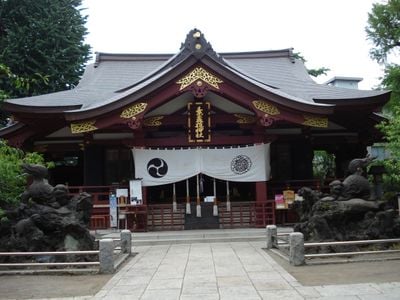
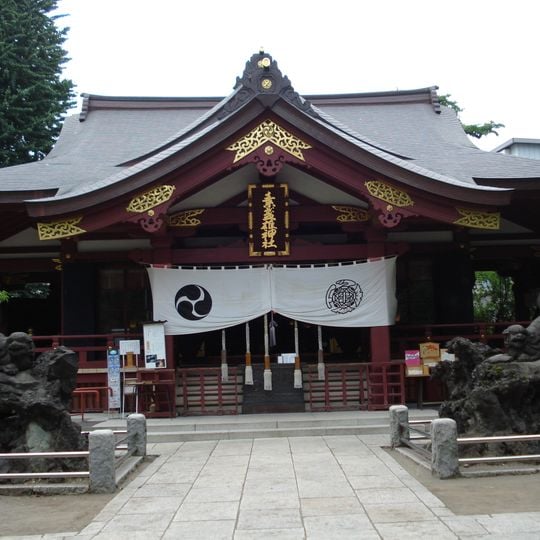
Susanoo Shrine in Minami-Senju has a dark grey tiled gable roof whose ridge rises to a curved peak crowned with a gold ornament. Gold openwork panels with floral motifs sit under the eaves, above a purple-brown gabled porch. A white cloth banner with two black crests hangs across the front, a dark plaque with gold characters beneath the gable, and two stone guardian figures flank the approach.
Founded in 795, when, according to tradition, the disciple Kokuchin received an oracle from Susanoo and Asuka deities and enshrined a rock at Kotsukahara. The two kami were housed separately until a 1718 fire; nine years later the Zuirakuden hall united them. During the 1858 cholera epidemic pilgrims flocked here for talismans. In the early Meiji period the shrine took its present name.
Locals call the shrine O-Tennō-sama, and its June 2–3 Tennō Festival is a city rite to ward off summer epidemics, like Kyoto's Gion Matsuri. Every third year since 1541 the o-mikoshi weighing 1,000 kan (3,750 kg) is carried on two 8.1 m poles, the nitebō, with cries of "oisa", "yā" and "uri". On September 15 the Asuka Festival holds a yudate rite.
Susanoo Shrine stands at 6-60-1 Minami-Senju, Arakawa, about seven minutes on foot from Minami-Senju Station. The Tennen Festival runs on 2-3 June, with the portable shrine procession on the weekend after; the Asuka Festival's yudate rite is held on 15 September. The Inari festival falls on the second Horse Day of February.
The shrine's portable mikoshi weighs 1,000 kan (3,750 kg) and is carried on two 8.1-metre poles, a two-pole style (nitenbō) rarely seen in Tokyo; the shrine's own procession has been held every three years since 1541. The grounds also hold a mound built in 1864 as a Fuji replica, enshrining the sacred stone tied to the shrine's founding.
The community of curious travelers
AroundUs brings together thousands of curated places, local tips, and hidden gems, enriched daily by 93,442 contributors worldwide.