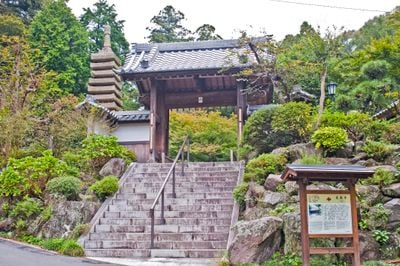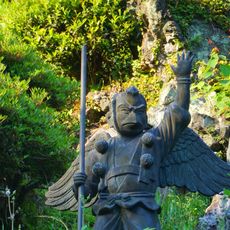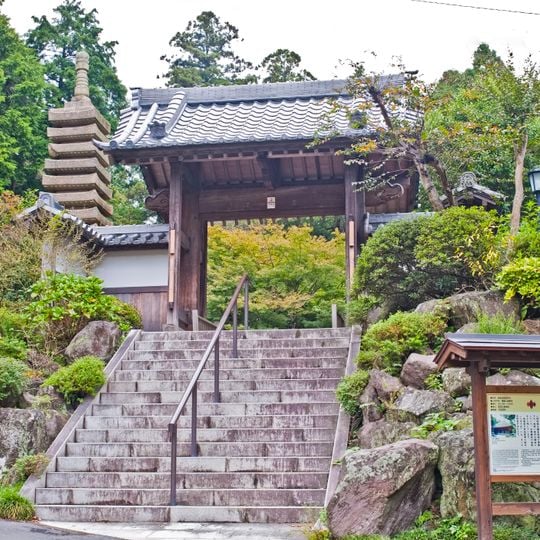
Kakuon-ji Temple, Buddhist temple in Nikaidō, Japan
Kakuon-ji is a Shingon temple of the Sennyū-ji school in the Yagura valley of Nikaidō, Kamakura. Its precinct is a national historic site. The main hall, the Yakushi-dō, is a thatched, hipped-roof hall built in the Zen style with a mirror ceiling and exposed rafters. The entrance faces the Aizen-dō, and a path leads past the Jizō-dō and a relocated Edo-period farmhouse.
The temple began as the Ōkura Yakushi-dō, built by Hōjō Yoshitoki in 1218 after the deity Hōjō Sadatoki appeared in a dream. In 1296 Hōjō Sadatoki converted it into a formal temple, appointing Chikai Shin'e as founding abbot. The main hall burned in 1337 and was rebuilt by Ashikaga Takauji in 1354; a 1830 fire destroyed most of the complex.
Kakuon-ji belongs to the Shingon-shū Sennyū-ji school, though it was originally a center of the Ritsu tradition combining Ritsu, Tendai, Tomitsu (Shingon), Zen and Jōdo studies. Its name is associated with the Hōjō regents, and the temple holds a Black Jizō statue whose festival, the Kuro Jizō Ennichi, is held on 10 August from midnight to noon.
The temple sits in a residential area and is best reached on foot, so wear sturdy shoes and allow time for walking. The path goes through quiet streets, so it helps to plan your route in advance.
The Yakushi Hall's beam plaque carries handwritten inscriptions by Ashikaga Takauji and abbot Bokugai Shijun. The hall's ceiling painting is by Kanō Norinobu, and timbers from the 1354 predecessor hall survive in the ceiling and structure.
The community of curious travelers
AroundUs brings together thousands of curated places, local tips, and hidden gems, enriched daily by 95,351 contributors worldwide.