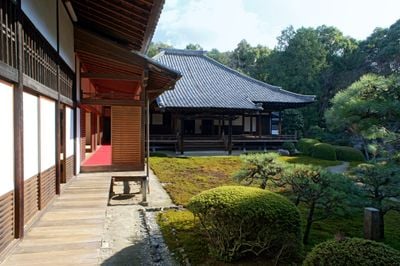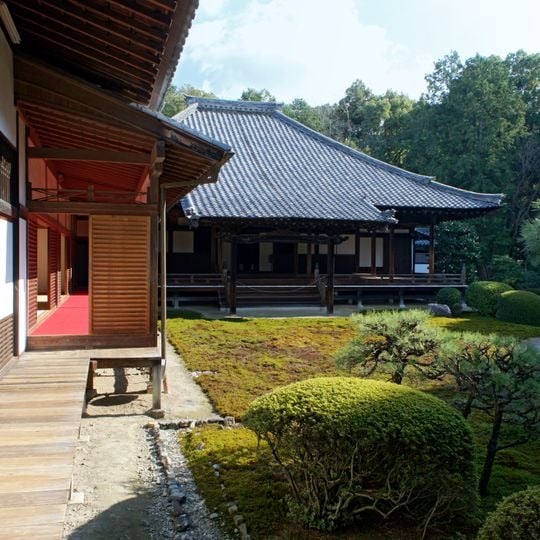
Zuishin-in Temple, Buddhist temple in Yamashina-ku, Japan.
Zuishin-in is a Buddhist temple in Yamashina-ku, a quiet district east of central Kyoto, registered as a historic site of Japan. The temple grounds hold a plum garden with around 200 trees of different varieties, including deep red mountain plums and pale pink types that open their flowers in March.
Ningai (954–1046), founder of the Ono branch of Shingon, established Mandara-ji on land granted by Emperor Ichijō in 991; Zuishin-in began as its subtemple. It became a monzeki temple in 1229 under the seventh abbot Shingen. Fire during the Jōkyū and Ōnin wars destroyed most buildings, and the temple moved repeatedly until the 24th abbot Shōkō (of the Kujō family) returned it to the Mandara-ji site in 1599 and rebuilt the main hall.
The site carries a close connection to Ono no Komachi, a poet from the Heian era, whose memorial tower and a ceremonial well called Keshō-i remain on the grounds. Visitors today see traces of this literary tradition in the structures that preserve the poet's memory.
The temple opens daily from 9:00 to 16:30, and the entrance fee is 500 yen for adults. From Ono Station, the grounds are about a five-minute walk through quiet residential streets.
The temple's Kongōsatta statue, a seated figure from the Kamakura period, is attributed to the sculptor Kaikei, and a red ink inscription inside it reads "巧匠法眼快慶". The temple also keeps a seated Amida from the late Heian period, designated an Important Cultural Property in 1917.
The community of curious travelers
AroundUs brings together thousands of curated places, local tips, and hidden gems, enriched daily by 93,465 contributors worldwide.