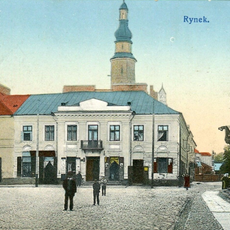
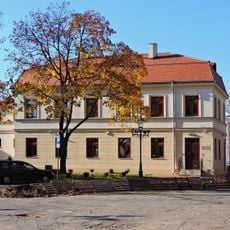
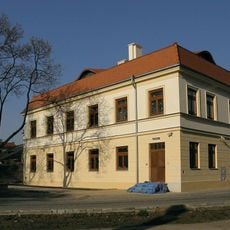
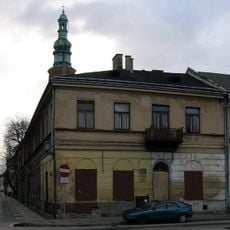
City walls of Radom, Medieval fortification in Radom, Poland
The City walls of Radom are a medieval fortification system that survives through scattered preserved sections of the former defensive perimeter. The structure combines stone foundations and brick elements with half-towers positioned at intervals along the line.
After Old Radom was destroyed, probably during a Lithuanian raid, Casimir the Great founded the New Town on Magdeburg law in 1350 or 1351 and enclosed it with walls in the second half of the 14th century. The walls were later raised by about 80 cm and survived until the Third Partition of Poland. Around 1815 they were demolished and replaced by Spacerowa (now Reja) and Wałowa streets.
The name of the Iłżecka (Krakowska) Gate comes from the road leading to Iłża and Kraków. The gate's 15th-century Madonna sculpture survives, and beneath it was a stone inscribed OPUS REGNI CASIMIRI 1357. The preserved walls are part of the Zabytki Radomia tourist route.
Fragments survive at Wałowa Street, in the walls of the Piarist college and the Royal Castle, with a reconstructed section on Szewska Street and the course marked on the Unii Radomsko-Wileńskiej square. The Kraków Gate sculpture of the Madonna is on Wałowa. The walls are private property in places, so view them from public streets.
The only surviving gate sculpture is a 15th-century Madonna on the Kraków (Iłżecka) Gate, once set above a stone inscribed OPUS REGNI CASIMIRI 1357. In 2010 an architectural competition was announced to rebuild the gate fully, but the contested project was never carried out.
The community of curious travelers
AroundUs brings together thousands of curated places, local tips, and hidden gems, enriched daily by 94,693 contributors worldwide.