Pałac w Małej Wsi, Neoclassical palace in Mała Wieś, Poland
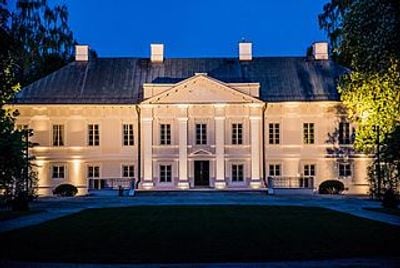
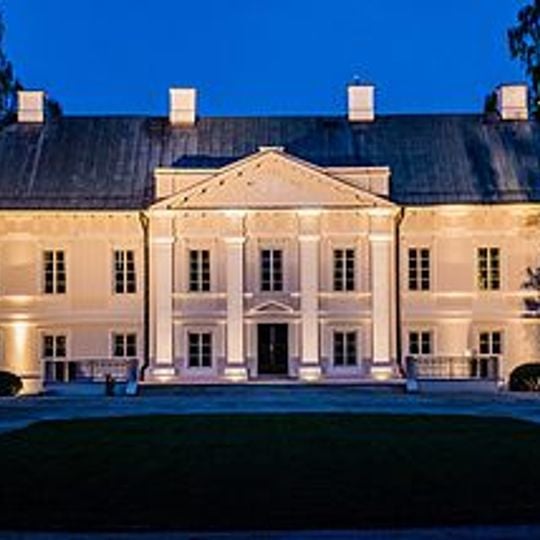
Pałac w Małej Wsi is a two-storey neoclassical palace with a symmetrical light-coloured facade and a steep dark roof with four rectangular chimneys. The central section projects beneath a triangular pediment framed by four flat pilasters, with a tall dark double door reached by a short flight of steps. A wooden plaque by the door reads "Anno Dni 1786. D. 3 Junij. Wprowadzenie do pałacu".
Bazyli Walicki, a supporter and economic adviser to King Stanisław August Poniatowski, commissioned the palace from architect Hilary Szpilowski. It was built between 1783 and 1786, and the family moved in on 3 June 1786, a date recorded on a wooden plaque still kept by the entrance. The king visited on 20–22 July 1787. Around the early 19th century Fryderyk Lessel rebuilt it, detaching the four side pavilions from the main block.
The palace was the centre of local life and, through Zdzisław Lubomirski's position, also a hub of the reborn Polish state. A wooden plaque by the door, kept under glass, records the entry on 3 June 1786: "Anno Dni 1786. D. 3 Junij. Wprowadzenie do pałacu". A stone in the park marks King Stanisław August Poniatowski's visit of 20–22 July 1787.
The palace stands behind a lawn, reached by a short flight of steps to the central double door; a low wall with railing runs along the base of the facade. The building is a protected monument, so visits concern the exterior and grounds rather than hotel rooms.
A wooden plaque fixed in a recess beside the door, protected by glass, records the move-in date: "Anno Dni 1786. D. 3 Junij. Wprowadzenie do pałacu". A stone placed in the park a century later marks King Stanisław August Poniatowski's visit of 20–22 July 1787, when he stopped here on his way back from meeting Catherine the Great.
The community of curious travelers
AroundUs brings together thousands of curated places, local tips, and hidden gems, enriched daily by 93,132 contributors worldwide.