Rheinbaben Palace, Palace in Michałkowice, Siemianowice Śląskie, Poland
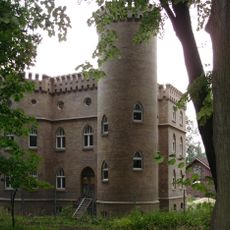
Rheinbaben Palace is a single-storey brick building on a rectangular plan with plastered elevations, a two-storey central bay and a three-storey side bay, all under gabled roofs. A cast-iron arabesque canopy covers the main entrance, and a terrace with steps faces the park. Inside are a fireplace room, a ballroom connected to the orangery, and a mirror hall seating 130.
A wooden manor of the Mieroszewski family, reinforced with brick floors and a gate tower from the 16th century, stood here first. In 1741 Jan Krzysztof Mieroszewski married his daughter to a Schwellengröbel officer, passing Michałkowice to that family and later to the Rheinbabens, who built the palace in 1836 or 1870. Hugo zu Hohenlohe-Öhringen bought it in 1892, and in 1906–1907 an orangery by Louis Dame was added. After 1945 the Michał coal mine ran it as a works culture house; the town regained ownership in 2009 after years in court.
The palace serves as part of Siemianowickie Centrum Kultury, hosting art workshops, concerts, and educational events that engage visitors of all ages. These activities bring together the local community around artistic expression and learning.
The palace stands in Górnik municipal park, which also holds a neo-Gothic forester's lodge. The building is entered at ground level, and the mirror hall, orangery and art studios occupy the same floor. The first stage of renovation, in 2017–2018, renewed the façade, roof covering and window frames.
The cast-iron arabesque canopy over the main entrance is a detail easy to miss. The palace stands in what is now Górnik municipal park, which also holds a neo-Gothic house for the forester and gardener. The orangery added in 1906 or 1907 was designed by Louis Dame.
The community of curious travelers
AroundUs brings together thousands of curated places, local tips, and hidden gems, enriched daily by 93,678 contributors worldwide.