Stożek Perkuna, Volcanic cone in Lower Silesia, Poland.
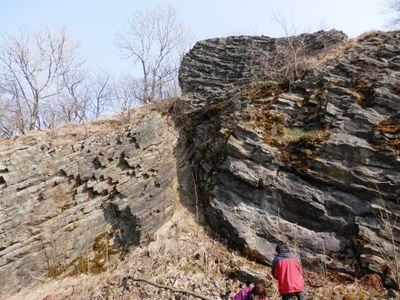
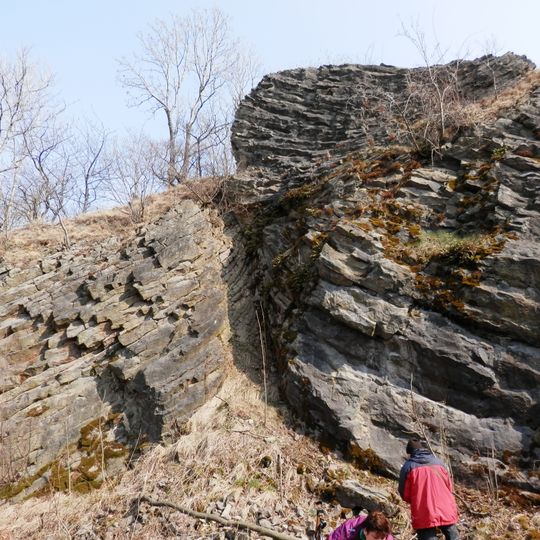
Stożek Perkuna is a volcanic form on Ciasnota hill (401 m a.s.l.) in the Izera Foothills near Grabiszyce, Lower Silesian Voivodeship. It is built of basanite or nephelinite, with two basalt structures visible from the west: a lower one with thicker columns and an upper one with finer columns. It was protected as a nature monument in 1954.
The basalt columns of Stożek Perkuna are the subject of two competing explanations: one treats the rock as a dyke, a basalt vein forced between older strata, the other as a volcanic plug with two lava generations, a denser older one with coarser columns and a more mobile later one that cooled faster into finer columns. The hill was protected as a nature monument in 1954.
The name refers to Perkun, the thunder god of Baltic mythology, though the hill lies in the Izera Foothills near Grabiszyce in Lower Silesia. The link between a Baltic deity and a Silesian hill is a naming puzzle rather than a documented local cult. Visitors today come for the rock and the view, not for the god.
You can park near the village of Lesna-Miloszowa and follow a walking trail of roughly one kilometer to reach the volcanic cone. The route is straightforward and well marked, making the site accessible to walkers of different ability levels.
The rock face on the western side shows two basalt layers: coarser columns below and finer ones above. Geologists read this as either a dyke or a two-generation volcanic plug, where more mobile lava intruded between older, thicker columns and cooled faster.
The community of curious travelers
AroundUs brings together thousands of curated places, local tips, and hidden gems, enriched daily by 94,764 contributors worldwide.