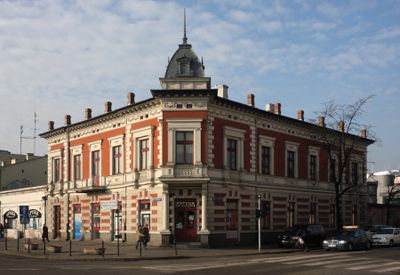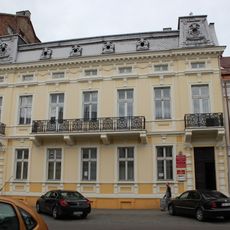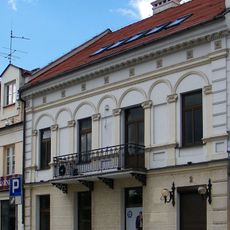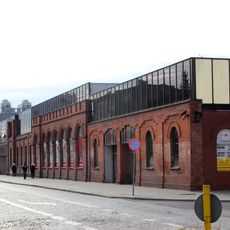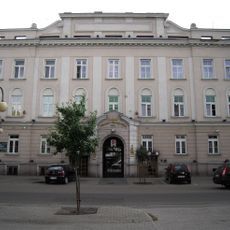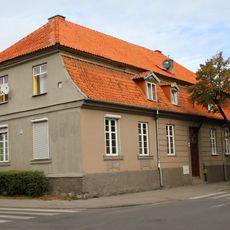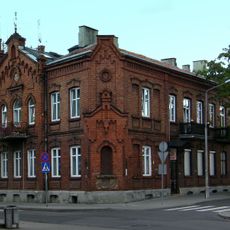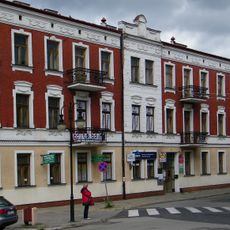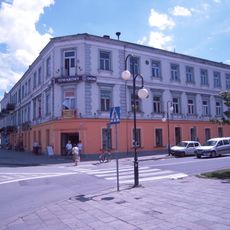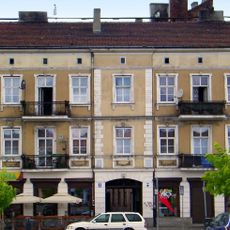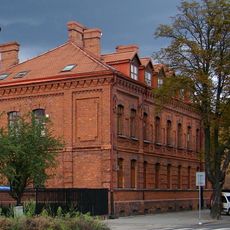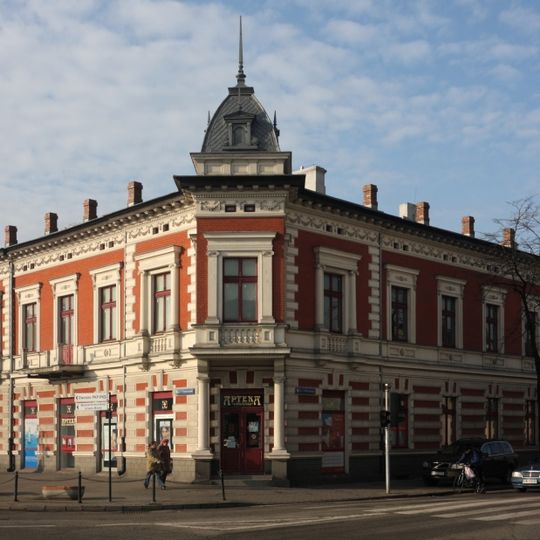
Hugo Mühsam's commercial-residential building, Commercial palace in Włocławek, Poland.
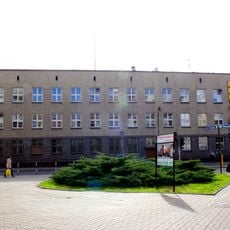
Pałac Mühsama is an eclectic corner townhouse at Plac Wolności and Kilińskiego Street, built around 1884 to Antoni Olszakowski's design. It is faced in facing brick with rich plaster architectural detail referring to French Renaissance traditions. The building originally housed the Dom Rolniczy, with living quarters for the Mühsam family and premises of their industrial and trading firm.
The building was erected around 1884 for Hugo Mühsam, a social activist and industrialist who owned an agricultural machinery and tool factory and an iron foundry; Antoni Olszakowski designed it. It first housed the Dom Rolniczy, partly residential for the Mühsam family and the seat of their industrial and trading firm, and for a time a factory office. After World War II it was used by the Kujawskie Zakłady Maszyn Rolniczych, was bought from the city in 1993 and restored at the start of the 21st century.
The structure shows how Jewish business owners shaped the economic life of the city in the late 1800s. The combination of shop and home under one roof reflects how merchants and factory owners worked and lived in that era.
The building stands at the corner of Plac Wolności and Kilińskiego Street in the Śródmieście district. It is a private property and a registered monument, so visitors see it from the street; the corner position lets you compare both facades.
The building was designed by architect Antoni Olszakowski and erected around 1884, not 1894. It stands at the corner of Plac Wolności and Kilińskiego Street in the Śródmieście district. Its eclectic style mixes facing brick with rich plaster detailing that refers to French Renaissance traditions.
The community of curious travelers
AroundUs brings together thousands of curated places, local tips, and hidden gems, enriched daily by 94,852 contributors worldwide.