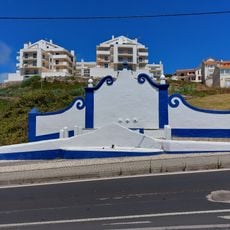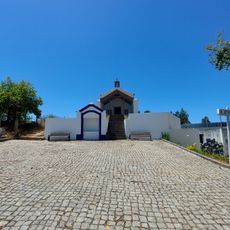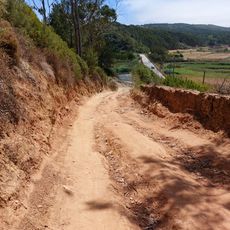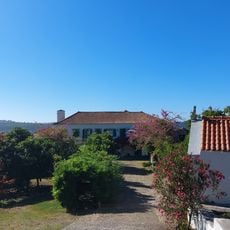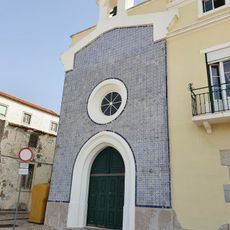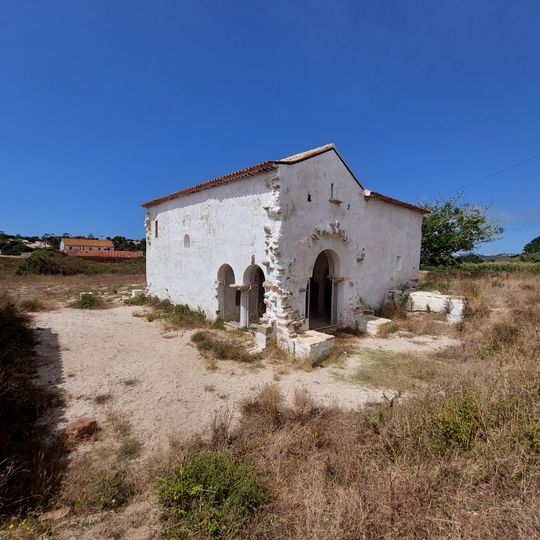
Igreja de São Gião, Medieval religious monument in Famalicão, Portugal.
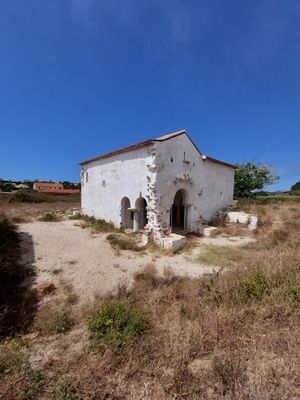
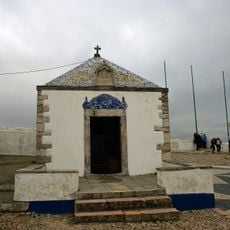
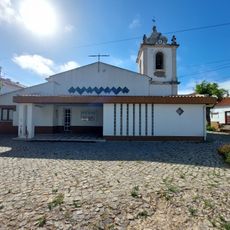
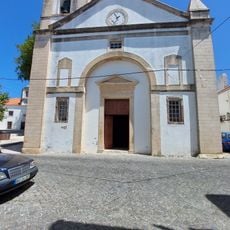
Igreja de São Gião is a rectangular stone church with a gabled roof and a central rounded arch entrance that repeats along its lateral walls. The building sits west of Casal Mota at the base of Serra da Pescaria.
Discovered in 1961 by Eduíno Borges Garcia at Quinta de São Gião, the church was first classified by Helmut Schlunk in 1971 as a Visigothic temple of the 7th century, supposedly built over a Roman shrine to Neptune. Carlos Alberto Ferreira de Almeida argued in 1986 for Asturian features and a 10th-century date, followed by Manuel Luís Real in 1995; a 2003 study by Caballero, Arce and Utrero found reused Visigothic sculpture in the walls. Frei Bernardo de Brito described it in good condition in 1597; it served as a cattle shed by 1702 and was declared a National Monument in 1986.
The name São Gião may refer to Saint John the Baptist or to Saint Julian, a saint linked to the consecration of coastal sites. Frei Bernardo de Brito, writing in 1597, noted that São Gião was especially venerated in the Visigothic period and was a particular favourite of this settlement. The church is thought to be connected to the Christianisation of the Nazaré coast, possibly sheltering the monk Romano and King Rodrigo in 711 with relics of Saint Bartholomew, Saint Blaise and an image of Our Lady of Nazaré.
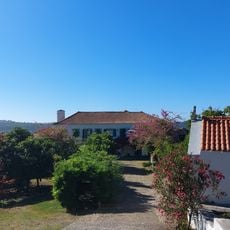
The church stands in the Quinta de São Gião, beside the dunes about 500 m from the sea and 5 km south of Nazaré, in the parish of Famalicão. Access is by the roads of that parish, not from Ponte da Barca, which lies far to the north. The surrounding land is cultivated and sandy; visitors cross it on foot from the nearest lane.
Archaeological campaigns between 1965 and 1999 revealed hidden internal structures, including opus signinum flooring and traces of earlier construction phases. These discoveries help explain how the building was modified multiple times over the centuries.
The community of curious travelers
AroundUs brings together thousands of curated places, local tips, and hidden gems, enriched daily by 93,118 contributors worldwide.