Ada Kaleh, Ottoman island in the Danube River, Romania
Ada Kaleh was a low, elongated island on the Danube, less than two kilometres long and about half a kilometre wide, lying some 3 km downstream of Orșova. A light-coloured masonry embankment rimmed the waterline, behind which low, pale-walled houses with dark pitched roofs stood tightly packed along narrow lanes. One longer building with a broad pale facade rose near the centre-left.
The Teutonic Knights mentioned the island as Saan in a report of 22 February 1430. In 1689 the Austrian army built a fortress there, and after the 1739 Treaty of Belgrade it returned to the Ottoman Empire, with a brief Austrian occupation from 1789 to 1791. Overlooked at the 1878 Congress of Berlin, it stayed a de jure Ottoman possession until the 1923 Treaty of Lausanne made it Romanian. It was submerged in 1970.
Islanders spoke a Western Rumelian Turkish dialect and practised Sufism; men wore the fez and women the çarşaf until Romania's socialist authorities banned them. Hungarian Turkologist Ignác Kúnos collected 150 folk songs here, including Ötme bülbül ötme yaz bahar oldu, though he recorded no melodies. The island was also known for Turkish oil wrestling and its football team.
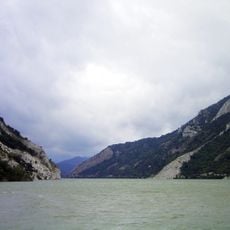
The island lies under the Iron Gates I reservoir, about 3 km downstream of Orșova, and can only be seen as a submerged site. The attempt to rebuild its main monuments on Șimian Island was never completed, though a project to recreate them there still exists. Most former residents moved to Dobruja or emigrated to Turkey.
The plan to rebuild the island's main monuments on Șimian, downstream, was never completed, and the idea has not been abandoned: a project to reconstruct them there still exists. Most islanders preferred to move to Dobruja or emigrate to Turkey.
The community of curious travelers
AroundUs brings together thousands of curated places, local tips, and hidden gems, enriched daily by 93,142 contributors worldwide.