Sirmium, Roman archaeological site in Sremska Mitrovica, Serbia.
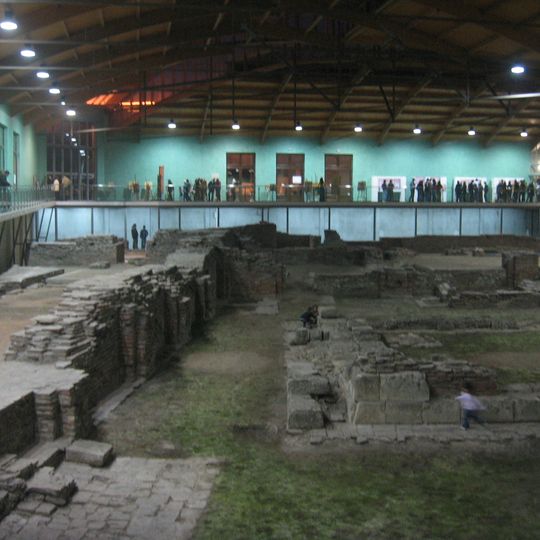
Sirmium lies beneath modern Sremska Mitrovica, with excavated remains set in a sunken area below a raised walkway and a pale green wall. Low stone and brick foundations in grey, tan and pale brown form irregular walls and floor fragments. A large rectangular sunken room with straight-edged stone walls occupies the centre-right foreground, surrounded by lower scattered remains; to the left, ruined masonry rises in stepped sections.
A Celtic settlement developed here from the 4th century BC, before Rome took control. The elevation to imperial capital occurred at the end of the 3rd century, when the empire was divided into four administrative regions.
The name Sirmium means "flow, flowing water, wetland", referring to its position on the Sava. The region of Syrmia (Srem) was named after the city. A Christian community existed here by the 3rd century; its first known bishop, Irenaeus, was martyred in 304 during the Diocletianic persecution.
The site is located in the center of the modern city and is easily accessible on foot. Signs in English and Serbian explain the main structures along the visitor route.
Archaeologists found workshops here where coins were minted for the entire Balkans. The minting stamps and blanks show that several production lines worked simultaneously.
The community of curious travelers
AroundUs brings together thousands of curated places, local tips, and hidden gems, enriched daily by 94,358 contributors worldwide.