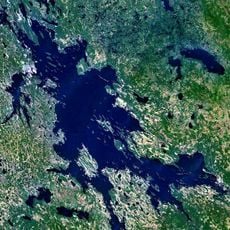
Vodlozero, lake in Republic of Karelia, Russia
Vodlozero is an elongated lake in the Pudozhsky District of southeastern Karelia, stretching 36 km north to south and 16 km wide, with a surface area of 322 km². Its basin is glacial in origin, its shores are low and rocky, and coniferous forest of spruce, pine and larch grows along the banks. The water is dark yellow and warms to 18–22.5 °C in July. The lake holds 196 islands covering 34 km², the largest being Kanzanavolok at 6.2 km².
The lake's basin is of glacial origin. Up to 40 small villages once stood on its shores and islands, grouped in the Prechistensky and Ilyinsky pogosts and inhabited by the Vodlozery, a local group of Russians. In 1935 wooden dams on the Vama and Sukhaya Vodla turned the lake into a seasonal reservoir for timber floating; this ended in the 1990s, and a concrete dam built at the Vama outlet in 2006 restored a natural hydrological regime.
The region has a deep connection to Russian North culture, visible in traditional building styles and old settlement patterns that still exist today. The few remaining villages like Kuganavolok keep these craftsmanship traditions alive.
The lake lies in Pudozhsky District inside Vodlozersky National Park, created in 1991. Kuganavolok, on a long cape in the south, is the largest settlement and the usual starting point. The water warms to 18–22.5 °C in July; the lake freezes in November–December and opens in April–May.
In 1935 wooden dams on the Vama and Sukhaya Vodla turned the lake into a seasonal reservoir for timber floating; the practice ended in the 1990s. A concrete dam replaced the wooden one at the Vama outlet in 2006, returning the water regime to its natural state.
The community of curious travelers
AroundUs brings together thousands of curated places, local tips, and hidden gems, enriched daily by 94,755 contributors worldwide.