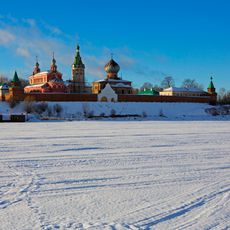
Volkhov Reservoir, reservoir in Leningrad Oblast, Russia
The Volkhov Reservoir is a large body of water in Leningrad Oblast that forms where the Volkhov River flows from a lake. The water collects here and moves through the region as part of a management system that supplies water to nearby communities and industries while controlling flood levels.
The reservoir was created by damming the Volkhov River for the Volkhov hydroelectric station, and filling began in 1926. It was designed by the Lengidroproekt institute. Its single-chamber shipping lock is filled through bottom galleries. The reservoir regulates seasonal fluctuations in the river's flow.
The reservoir's fish population is a defining local feature: ide, pikeperch, northern and small whitefish, and pike are caught here, and fishing is one of its established uses alongside hydropower and navigation. The water level varies by up to 3 m, a rhythm that shapes how the shoreline is used through the year.
The reservoir consists of a river section about 200 km long and a lake section that includes Lake Ilmen. Water levels fluctuate by up to 3 m, so shorelines and shallows shift through the year. The reservoir is used for hydropower, navigation and fishing, with a single-chamber shipping lock filled through bottom galleries.
The reservoir's single-chamber shipping lock fills through bottom galleries, a design by the Leningrad-based institute Lengidroproyekt. The dammed water backs up as far as Lake Ilmen, which lies within the zone of backwater, so the reservoir is made of a river section and a lake section.
The community of curious travelers
AroundUs brings together thousands of curated places, local tips, and hidden gems, enriched daily by 94,550 contributors worldwide.