Petropavlovsky Park, Federal cultural heritage park in Yaroslavl, Russia.
Petropavlovsky Park occupies the former territory of the Yaroslavl Great Manufactory (Polotnyany Dvor) in the southern part of Yaroslavl. Its layout follows the course of the Kavardakovsky stream, along which a cascade of five ponds was dug for the manufactory's water mills. The upper ponds were the central part of the park ensemble, where fish were bred; the fifth adjoined the owner's house. Of the regular park with fountains, sculpture and a pavilion, only its structure survives.
The park grew out of the regular estate laid out in 1722–1731 beside the Zatrapeznov merchants' linen manufactory, founded in the late 1720s on former marshland by the Kavardakovsky stream. In 1741 the works passed to Alexei Zatrapeznov as the Yaroslavl Great Manufactory. After the 1844 fire and the 1857 purchase by the Karzinkin and Igumnov merchants, the old factory buildings were dismantled for brick, and by the early 20th century the grounds had become a public garden. Soviet-era neglect ruined the fountains, sculpture, pavilion and orangery.
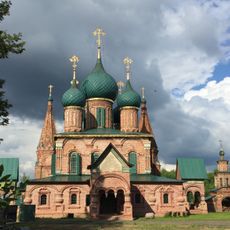
The park's name survives from the Petropavlovsk church that Ivan Zatrapeznov built in the 1730s as a memorial to Peter I. Under the Bolsheviks it was renamed twice, for workers fallen against counter-revolution in 1922 and for the 16th Party Congress in 1930, yet Yaroslavl residents kept calling it Petropavlovsky. At Easter the factory owners opened their estate garden to all comers.
The park lies in the southern part of Yaroslavl on the former territory of the Bolshaya Manufactory, with the Kotorosl and the Rybinsk railway line near its north-eastern edge. The five ponds of the old estate cascade along the Kovardakovsky stream, though it is partly filled in and dug over. A 1990 survey found the grounds overgrown and the buildings derelict, and later clean-ups cleared the ponds and drainage but no restoration project was carried out.
The five ponds along the buried Kovardakovsky stream were dug for the manufactory's water mills: the first was the "dirty" pond where linen was rinsed and people bathed, the second served "clean" needs, and the third and fourth held fish. The stream itself is now partly filled in and dug over.
The community of curious travelers
AroundUs brings together thousands of curated places, local tips, and hidden gems, enriched daily by 93,883 contributors worldwide.