Staraya Ladoga mounds, Archaeological burial mound in Staraya Ladoga, Russia.
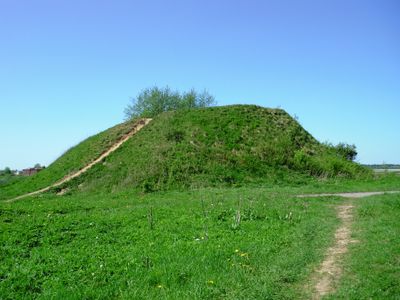
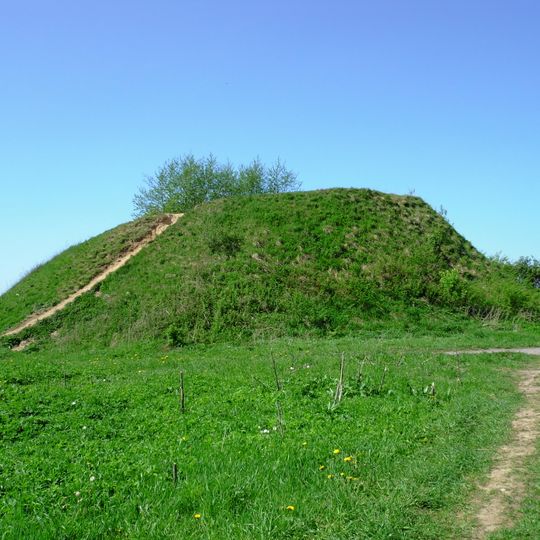
The Staraya Ladoga mounds include the 10-metre-high Olegova Mogila, also called Sopka Khodakovskogo or the Hollow Mound, in the Sopki tract near Staraya Ladoga. A dirt path climbs its grassy left slope, and its upper part is covered with dense shrubs. It is mound 5-III in V. P. Petrenko's numbering of the northern Volkhov mounds.
The mound 5-III was partially excavated in 1820 by Zorian Dolega-Hodakovsky, who dug into about a third of the fill and found burned bones, a two-barbed socketed spearhead dated to the 8th or early 9th century, a piece of iron like a lock latch, and charcoal. No further excavations have been conducted. The name "Oleg's Grave" was attached to this mound in the 1920s–40s, although the burial inventory indicates the mound was raised in the 8th century.
Local tradition calls this mound Oleg's Grave, though scholars date its cremation burial to the 9th century, earlier than Prince Oleg's death in 912 or 922. Folk accounts also speak of a grave heaped up "by handfuls" and of Rurik being buried here. The name was attached to the mound in the 1920s–40s.
The site is located outside the main town and requires a car journey from larger settlements. The area offers views across the river and allows walks around the mounds to see their structure from different angles.
Catherine II's 1783–1784 medal project No. 39, engraved by Timofei Ivanov, shows four burial mounds instead of the single grave described in the inscription, possibly reflecting her 1785 journey through the Ilmen basin. The mound itself is also called the Hollow Mound and was first linked to Oleg by N. E. Brandenburg in 1896.
The community of curious travelers
AroundUs brings together thousands of curated places, local tips, and hidden gems, enriched daily by 94,303 contributors worldwide.