Hever Castle, 13th-century castle in Kent, England
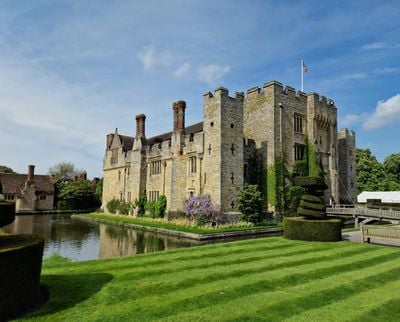
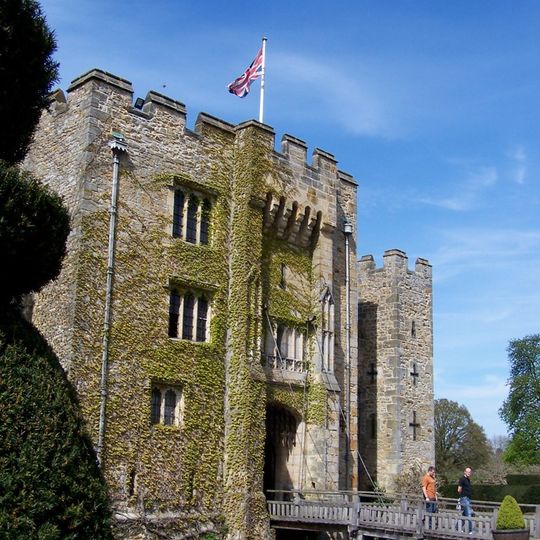
Hever Castle stands by the village of Hever near Edenbridge in Kent, begun in the 13th century as a country house and converted into a manor in 1462 by Geoffrey Boleyn. Its rough grey stone walls are largely covered with climbing ivy; the tall left facade rises to a crenellated roofline, a battlemented square tower with narrow stacked windows projects from it, and a squarer tower with vertical slit windows stands to the right. The gatehouse is the only surviving medieval part, and the timbers of the original house can be seen within the stone walls.
The oldest part, the gatehouse and a walled bailey, dates to 1270. In 1462 Geoffrey Boleyn converted the then-dilapidated castle into a manor, adding a Tudor dwelling within the walls. Thomas Boleyn inherited it in 1505; after his death in 1539 it passed to Henry VIII, who gave it to Anne of Cleves in 1540.
Hever Castle holds Anne Boleyn's prayer books and a large collection of Tudor paintings across its three floors. The gatehouse keeps the oldest working original portcullis in England, and a separate building houses the museum of the Kent and Sharpshooters Yeomanry. Summer brings jousting tournaments and archery displays, and September an annual patchwork and quilting exhibition.
The gatehouse, the only surviving medieval part, holds England's oldest working portcullis. The gardens lie beyond the moat-side village Astor built; the yew maze dates from 1904 and the water maze from 1999. Allow time to walk between castle, lake and gardens.
The gatehouse is the only surviving medieval part of the castle and holds the oldest working original portcullis in England. The timbers of the original 13th-century country house can still be seen inside the stone walls.
The community of curious travelers
AroundUs brings together thousands of curated places, local tips, and hidden gems, enriched daily by 92,586 contributors worldwide.