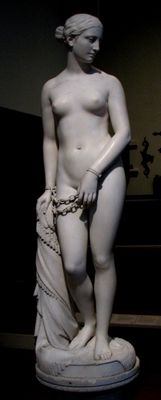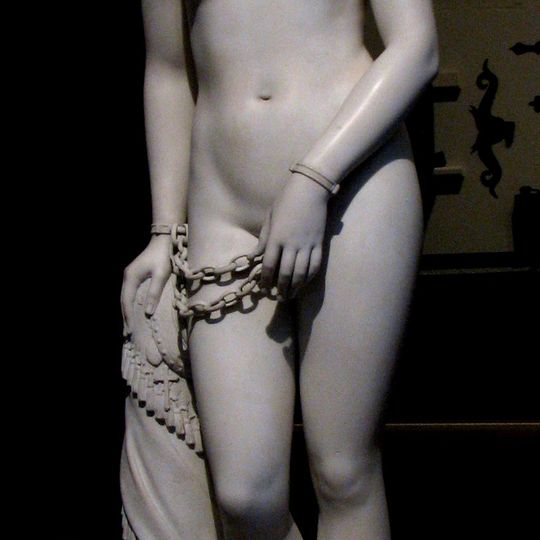
The Greek Slave, Marble sculpture series at Raby Castle, Smithsonian American Art Museum, and Yale University Art Gallery
The Greek Slave is a series of marble sculptures displayed across three major locations: Raby Castle in England, the Smithsonian American Art Museum in Washington, and Yale University Art Gallery. Each version portrays a woman standing in chains while holding a cross, representing a young Greek captive during the period of Ottoman rule.
The first marble version was completed in 1844 and attracted international attention when shown at the Great Exhibition in London in 1851. The work emerged during a period when abolition and freedom became central topics of debate across America and Europe.
The sculpture became a conversation piece in homes across the 1800s, with people displaying small ceramic versions as a way to express their views on slavery and human freedom.
Visitors can view the three marble versions by traveling to each location, though they are spread across different countries and regions. Each site displays the sculpture in its own gallery space where you can walk around and examine the carving details at your own pace.
The Smithsonian created a digital 3D scan of the sculpture that allows people to explore fine details online and produce physical replicas. This technology has made one of the 1800s most discussed artworks accessible to audiences worldwide without traveling.
The community of curious travelers
AroundUs brings together thousands of curated places, local tips, and hidden gems, enriched daily by 90,818 contributors worldwide.