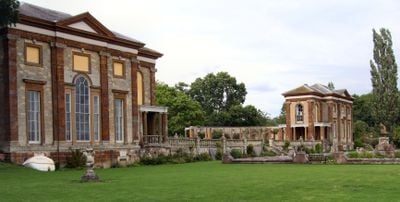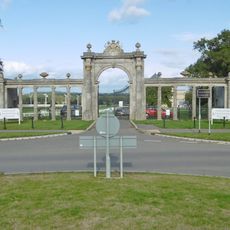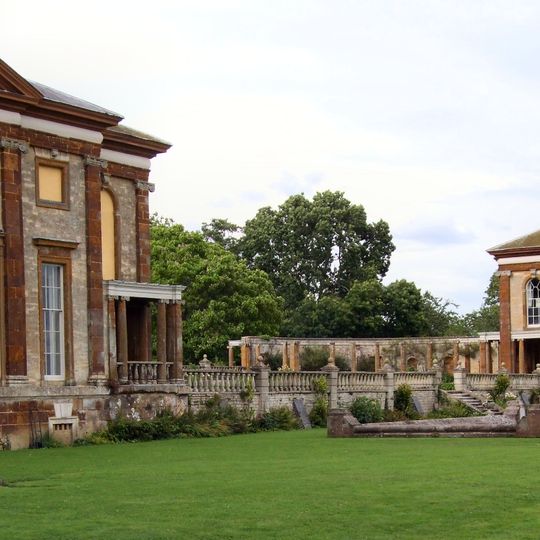
Stoke Park Pavilions, 17th century Palladian pavilions in Northamptonshire, England.
Stoke Park Pavilions are two surviving structures connected by a curved colonnade, set within a 400-acre park and representing early English Palladian design from the 1620s. The buildings display the symmetrical forms and classical proportions typical of this architectural style.
The deer park was acquired by Henry VIII in 1541 for hunting use before being granted to Sir Francis Crane in 1629. The pavilions were then built as one of England's first examples of Palladian architecture.
The pavilions were designed with specific purposes that shaped daily life on the estate, with one serving as a chapel and the other as a library. These functional spaces reveal how architecture organized social and intellectual activities for the household.
The pavilions are not freely accessible and require advance arrangements to visit. Guided tours are offered on select occasions and provide the best way to explore the buildings and learn about their history.
The mathematician and physicist Isaac Newton spent time at the estate in 1672 and wrote several letters during his stay. His presence documents the site as a place where scientific thought was exchanged during that era.
The community of curious travelers
AroundUs brings together thousands of curated places, local tips, and hidden gems, enriched daily by 60,000 contributors worldwide.