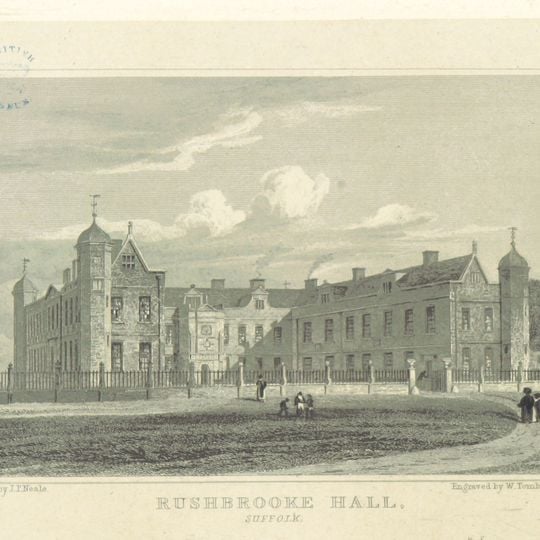
Rushbrooke Hall, Tudor manor house in Rushbrooke, Suffolk, England
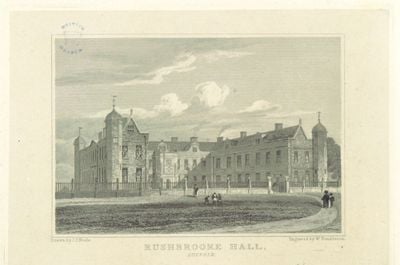
Rushbrooke Hall was a brick manor house in Suffolk, England, built around the middle of the 16th century, with an E-shaped plan, a central courtyard, and corner turrets. The entrance featured a large stone porch decorated with carved heraldry representing the families who owned it.
Sir Thomas Jermyn built the manor around 1550, and it stayed in the family until 1703, when ownership passed to Sir Robert Davers. The building survived for over 400 years before a fire led to its demolition in 1961.
The E-shaped layout of the hall was not just a design choice but a common way for Tudor families to signal their loyalty to the crown, as the shape echoes the initial of Elizabeth I. Guests arriving at the entrance would have immediately noticed the carved heraldry on the stone porch, a visible statement of the family's lineage and connections.
Nothing stands above ground today, so visitors will find only the earthwork remains and the water-filled moat that once surrounded the manor. The site is best explored on foot, and walking around the moat gives a clear sense of how large the original building must have been.
Queen Elizabeth I visited the estate in 1578 during her summer progress through East Anglia, making it one of the few private homes in Suffolk to receive a royal stay. Hosting such a visit was extremely costly for the family, as they were expected to feed and house the queen's entire travelling party.
The community of curious travelers
AroundUs brings together thousands of curated places, local tips, and hidden gems, enriched daily by 60,000 contributors worldwide.