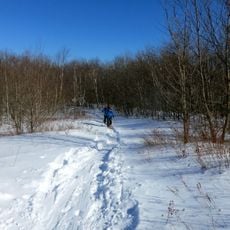
Northern boundary of Massachusetts, State boundary marker in Vermont, United States
The northern boundary of Massachusetts is a line of straight segments running eastward from the northwestern corner of the state. Granite markers placed at intervals along this line show precisely where Massachusetts meets Vermont to the north and New Hampshire to the northeast.
King George II set the current line in 1740, placing it three miles (about 5 km) south of the Merrimack River, ending decades of disputes between the colonies. The boundary has remained unchanged since then, becoming a fixed reference for the region.
The boundary reflects how different states developed their own ways of organizing land and government. Visitors walking along the marker line notice how the landscape and local character shift between the two sides.
The granite markers along the boundary help orient visitors looking for the exact spot where the states meet. The western end near the three-state junction is generally the easiest starting point, accessible on foot from nearby trails.
A copper bolt marks the exact point where Vermont, Massachusetts, and New Hampshire all meet in the far northwestern corner. Standing at that spot, a visitor can be in three states at once, which is rare in New England.
The community of curious travelers
AroundUs brings together thousands of curated places, local tips, and hidden gems, enriched daily by 60,000 contributors worldwide.