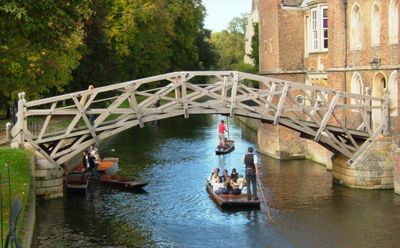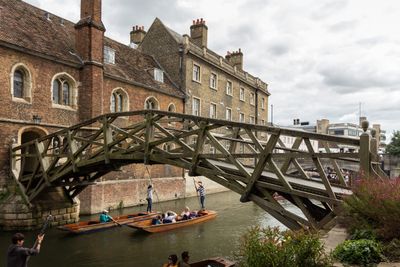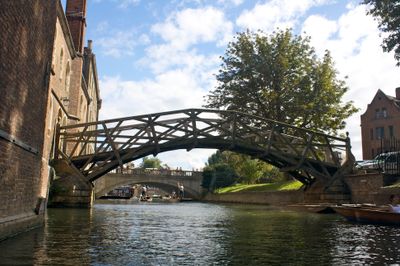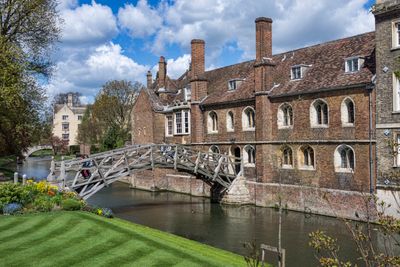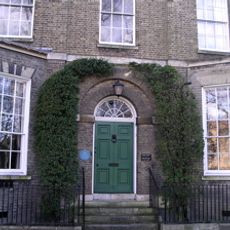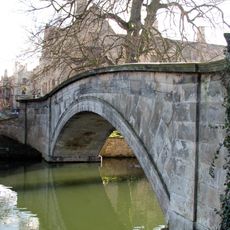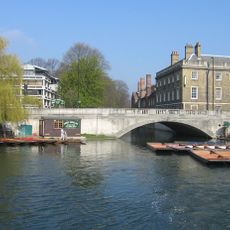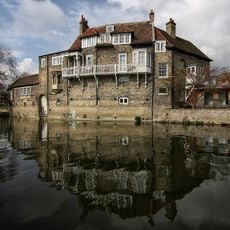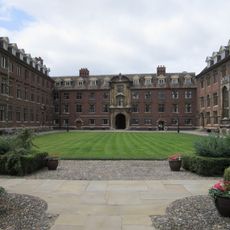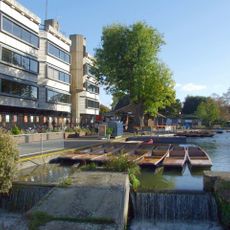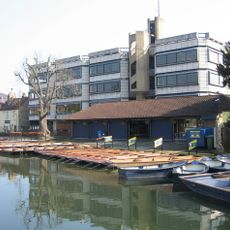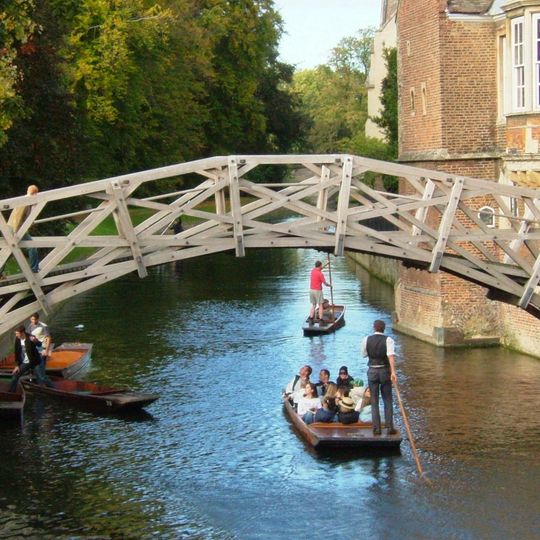
Mathematical Bridge, Wooden footbridge at Queens' College, Cambridge, England.
The Mathematical Bridge is a wooden footbridge over the River Cam connecting two parts of Queens' College in Cambridge and listed as a Grade II protected structure. The construction consists of straight beams arranged in a truss system that together form an arch shape without using curved components.
William Etheridge designed the first version in 1749 to connect the two riverside parts of the college. The current structure dates from a complete renewal in 1905, when teak replaced the original oak timber.
The name suggests a purely mathematical theory, though the bridge was built using eighteenth-century carpentry principles without requiring formulas for planning. Students and visitors examine the visible timber joints, which show how craftsmen worked without modern calculations yet created lasting constructions.
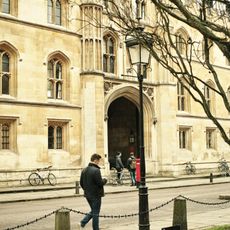
Access is through the main entrance of Queens' College on Queens' Lane, with entry often depending on college visiting hours. Guided tours offer a chance to view the construction closely, as the bridge sits within the college grounds.
A legend claims Isaac Newton designed the bridge without metal fasteners, though he had died before its construction. The story spread nonetheless and is sometimes told to visitors asking about the famous physicist, whose connection to the city is widely known.
The community of curious travelers
AroundUs brings together thousands of curated places, local tips, and hidden gems, enriched daily by 91,979 contributors worldwide.