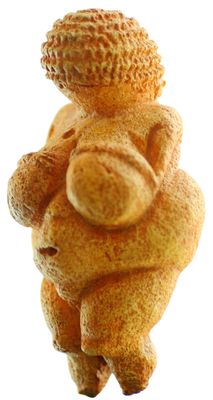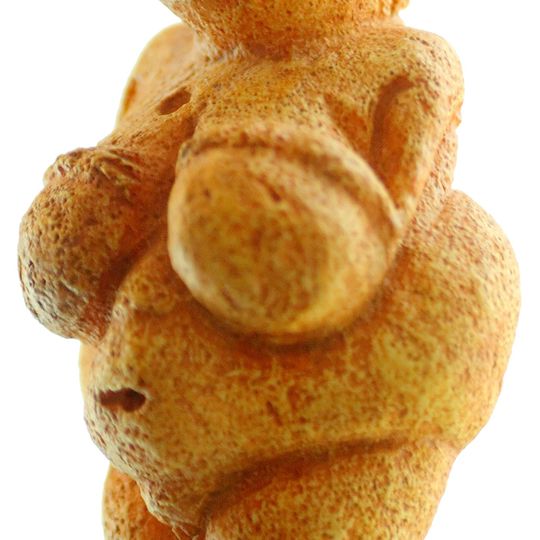
Venus of Willendorf, Paleolithic limestone sculpture in Natural History Museum, Vienna, Austria.
The Venus of Willendorf is a small limestone sculpture standing about 4.4 inches (11 centimeters) tall that depicts a female figure with emphasized body forms. It has no visible facial features and was carved from a porous rock type found in nature.
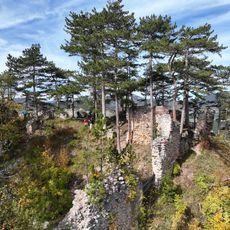
The sculpture was unearthed in 1908 during excavations near the village of Willendorf in Austria. It dates to the Gravettian period around 29,500 years ago and ranks among the oldest known human representations.
The figure is now understood as a symbol of fertility and female power in prehistoric times. It shows how early humans expressed their thoughts and values through carved forms.
The object is on display in the Natural History Museum Vienna within the prehistory section and can be viewed at close range. It is protected behind glass, so visitors can observe the details without being able to touch it.
Analysis of the stone reveals that it originated from the Lake Garda region in northern Italy, far from where it was found. This suggests that prehistoric people traveled vast distances or exchanged materials through ancient networks.
The community of curious travelers
AroundUs brings together thousands of curated places, local tips, and hidden gems, enriched daily by 90,815 contributors worldwide.