Castle Kynžvart, Neoclassical castle in Lázně Kynžvart, Czech Republic.
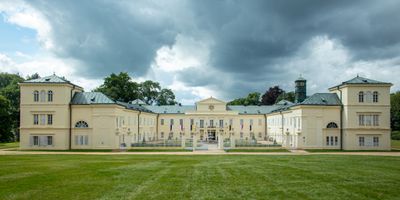
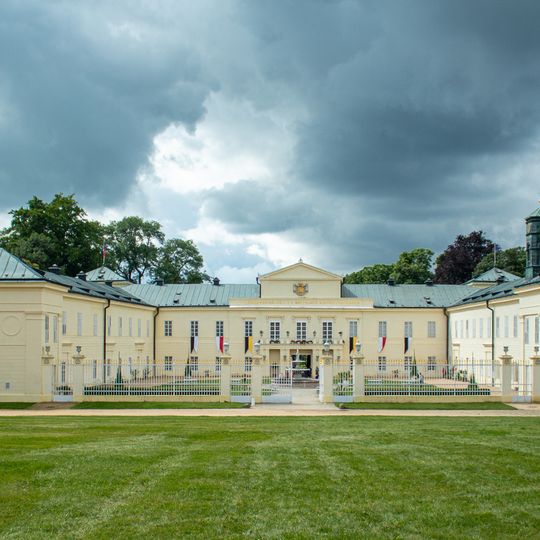
Castle Kynžvart is a three-wing neoclassical building with a pale yellow facade, a green hipped roof and a triangular pediment bearing a crest above the entrance, where an inscription reads "TEMPLUM VIRTUTI ET HOSPITALITATI". The Viennese architect Pietro Nobile rebuilt it between 1820 and 1839 for Klemens von Metternich, using stone from Kynžvart Castle about 3 km away. The tour leads through 25 rooms, among them the chancellor's library and a cabinet of curiosities.
The castle was transformed by Prince Klemens Metternich between 1821 and 1836, with architect Pietro Nobile contributing to the design of its new facades and interiors. Under Metternich's direction, it became a showpiece residence reflecting his position as one of Europe's most influential diplomats.
The castle chapel of St. Anthony of Padua, in its classicist form from 1833, has an altar made from marble remnants of the burned Basilica of St. Paul Outside the Walls in Rome, given by Pope Gregory XVI, who also donated the relics of St. Boniface. Pilgrimage Masses were held here until the 1950s and resumed in 1999.
The tour covers over 20 rooms, about two-thirds of the first floor, and lasts 50 to 60 minutes; guides explain in Czech and German. Changing exhibitions are held in the former stable on the ground floor and in part of the park. The castle stands about 1.5 km southwest of Lázně Kynžvart.
The castle's museum, founded in 1828, is among the oldest in Bohemia. Its cabinet of curiosities holds Egyptian monuments and marble sculptures, including works by Antonio Canova. The last executioner of Cheb, Karl Huss, served as its curator until his death in 1838.
The community of curious travelers
AroundUs brings together thousands of curated places, local tips, and hidden gems, enriched daily by 92,310 contributors worldwide.