Chest opened
+${chestReward.xp} XP
Explorer
NOUVEAU ×${chestReward.collectible.quantity}
tapez pour fermer

See the monuments around you in AR Open chests in the app

Around Us is built for your phone — point your camera at the streets and discover the monuments and places around you in augmented reality. Around Us is built for your phone — chests unlock when you walk, explore and capture nearby places.

•

Enable Location

We need your location to show you interesting places around you

Discover nearby places

Find interesting locations and hidden gems around you

Precise directions

Get accurate directions and distances to places

Your location is never shared with other users. It's only used when you tap the location button.

Adršpach

Log in to your account

Start exploring — it's free

Trusted by 92,666 travelers worldwide

Continue with Google
Continue with Apple
or

We will send you a code to connect

By continuing, you accept our Terms and Conditions and our Privacy Policy

Check your inbox

We've sent a pincode in your inbox. Please enter the code below.

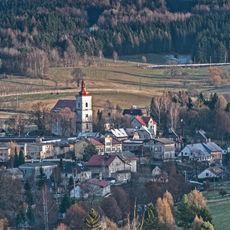
Adršpach, Gothic castle ruin in Dolní Adršpach, Czech Republic

Adršpach is a ruined Gothic castle on the flat top of Zámecký vrch at 681 m, about 2 km west of Adršpach village. Its three-part layout has a large outer bailey, a residential core against two rock formations, and an eastern core reached by a corridor cut into the rock; low wall fragments and rock-cut cellars remain.

Adršpach was probably founded by King John of Luxembourg in the 1320s or 1330s, and is first documented in 1348 in the Majestas Carolina. In 1430, during the Hussite Wars, a Hussite garrison seized the Catholic castle; it returned to the lords of Dubá in 1436. Its garrison raided Silesia, so in 1447 Silesian and Lusatian towns bought it for 900 Hungarian gold guilders and had it demolished.

The name comes from the personal name Eberhart, shortened to Eber, which first named the Ebersbach stream; records show forms such as Ebrspach (1348) and Adrspach (1393). The castle was held jointly by several owners in the 15th century, possibly as a Ganerbenburg, and its garrison raided Silesia.

The ruin is accessible via marked pathways that wind through hilly terrain west of Broumov in the Náchod district. Visitors should prepare for uneven ground and steep sections, so sturdy footwear is recommended.

In the 15th century several Silesian towns jointly purchased and demolished this fortress to remove it as a base for raiders. This unusual collective action reveals how vital the site had become for attacks in the region.

The community of curious travelers

AroundUs brings together thousands of curated places, local tips, and hidden gems, enriched daily by 92,666 contributors worldwide.

Start exploring
Location
Architectural style
Gothic architecture
GPS coordinates
50.61737,16.10018
Latest update
October 21, 2026 18:01
Reviews
Share your experience

No review yet

Discussions
Start a discussion...

No discussion yet

« Adršpach - Gothic castle ruin in Dolní Adršpach, Czech Republic » is provided by Around Us (aroundus.com). Images and texts are derived from Wikimedia project under a Creative Commons license. You are allowed to copy, distribute, and modify copies of this page, under the conditions set by the license, as long as this note is clearly visible.

Discover hidden gems everywhere you go!

From secret cafés to breathtaking viewpoints, skip the crowded tourist spots and find places that match your style. Our app makes it easy with voice search, smart filtering, route optimization, and insider tips from travelers worldwide. Download now for the complete mobile experience.

Around Us App Screenshot
❝

A unique approach to discovering new places❞

— Le Figaro

❝

All the places worth exploring❞

— France Info

❝

A tailor-made excursion in just a few clicks❞

— 20 Minutes

Around Us
Travel Guide & Maps
Download

Send to your phone

QR Code
1

Open the camera app on your mobile.

2

Point at the QR code with your camera. A notification will appear.

3

Tap the notification to open the link.