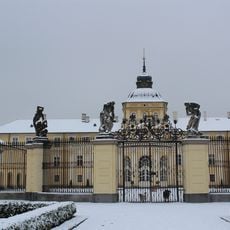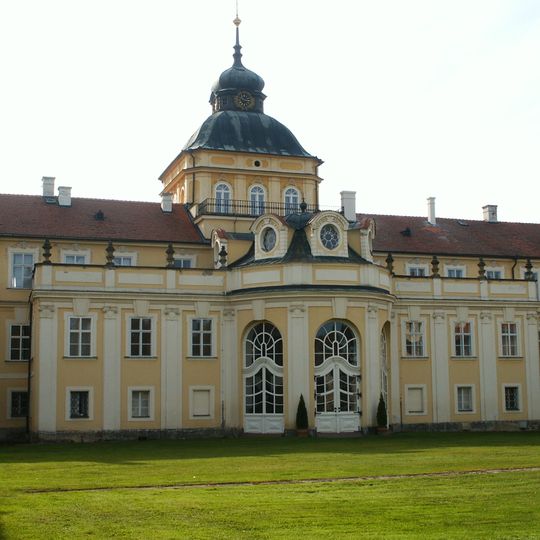
Hořovice Castle, Neoclassical château in Hořovice, Czech Republic.
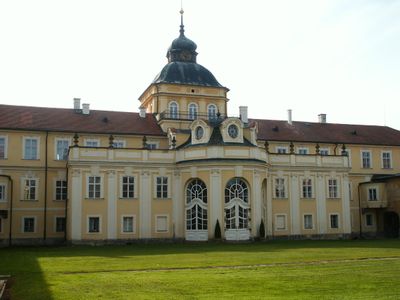
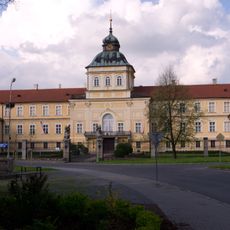
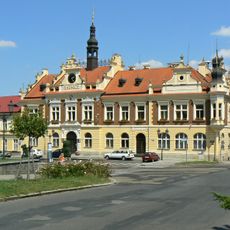
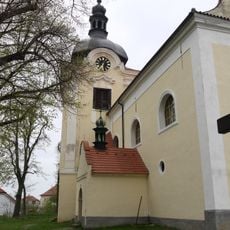
Hořovice Castle is an early Baroque building begun around 1700 by the Bruntálský of Vrbna family, given an H-shaped plan with two courtyards in a construction phase from 1737 lasting nearly twenty years. The main building was raised by a storey and topped with a tower in 1859–1861, and the present symmetrical layout dates from 1868.
The Bruntálský of Vrbna family built the early Baroque château around 1700, and it stayed in their hands until 1852. In 1852 the Hessian elector Frederick William I bought it for his morganatic wife Gertrude, later Princess of Hanau. Gottlob Engelhard's late Neoclassical rebuilding ran from 1856 to 1861, raising the main building and adding a tower; the neighbouring brewery was demolished in 1868 to complete the symmetrical H-shaped plan.
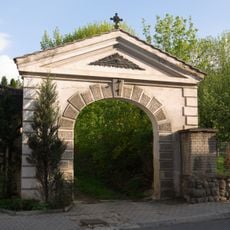
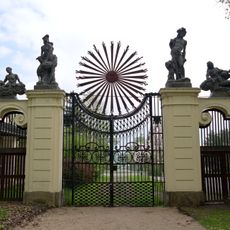
The name Hořovice comes from the castle's role as the seat of the Counts of Vrbna and later the Princes of Hanau. The honorary courtyard is separated from the park by a wall with wrought-iron grilles and sculpture from Matthias Braun's workshop, including the Hercules Gate; Braun's figures also decorate the Sun Gate at the park's southeast exit. The castle now hosts social events such as weddings.
The castle is managed by the National Heritage Institute and is open to the public; the grounds and halls also host social events such as weddings. The main building was raised by a storey and topped with a tower in 1859–1861, and the northeast wing was rebuilt in 1868 to give the plan its present symmetry.
The Hořovice estate was bought in 1852 for 2.5 million guilders by Frederick William I, Elector of Hesse, as a home for his morganatic wife Gertrude, made Countess of Schaumburg and later Princess of Hanau. Their descendants held it until 1945.
The community of curious travelers
AroundUs brings together thousands of curated places, local tips, and hidden gems, enriched daily by 92,374 contributors worldwide.