Theresienstadt Small Fortress, Military fortification and prison complex in Terezín, Czech Republic
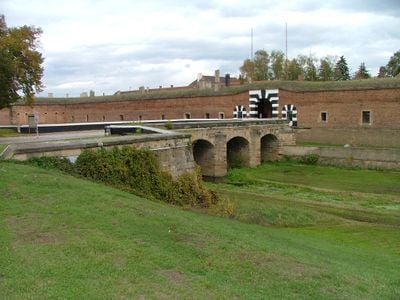
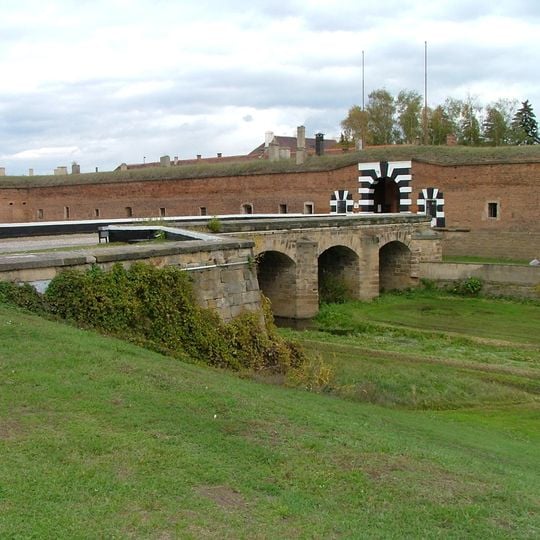
Theresienstadt Small Fortress is a fortification in Terezín, Czech Republic, built under Emperor Joseph II between 1780 and 1790 on the right bank of the Ohře River. Its long brick wall is pierced by arched openings and two large gateways framed in black-and-white painted masonry, with a smaller similar gate to their right. A three-arched stone bridge with a low parapet leads to the wall, whose top edge is capped with grass.
The fortress was built in the late 18th century under Emperor Joseph II as a military installation, and it later became a political prison under Habsburg and then Austro-Hungarian rule. During the Second World War, the Gestapo took it over and used it to hold thousands of prisoners under extreme conditions.
In many of the cells, visitors can still see names, dates, and drawings scratched or written onto the walls by former prisoners. These marks give a personal dimension to the visit that no display or label can replace.
The Small Fortress stands on the eastern side of Terezín, across the Ohře from the town's main square, and is reached on foot in a few minutes. The grounds are entered through the stone bridge over the moat, past the gateways with black-and-white painted masonry. Much of the visit is outdoors along the ramparts and courtyards, so allow time for walking between the prison blocks and the execution ground.
Gavrilo Princip, the man whose assassination of Archduke Franz Ferdinand in 1914 set off the First World War, was imprisoned here and died within these walls in 1918. His small cell can still be seen during a visit.
The community of curious travelers
AroundUs brings together thousands of curated places, local tips, and hidden gems, enriched daily by 93,998 contributors worldwide.