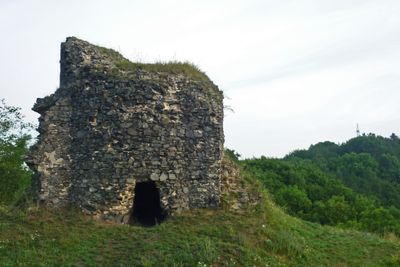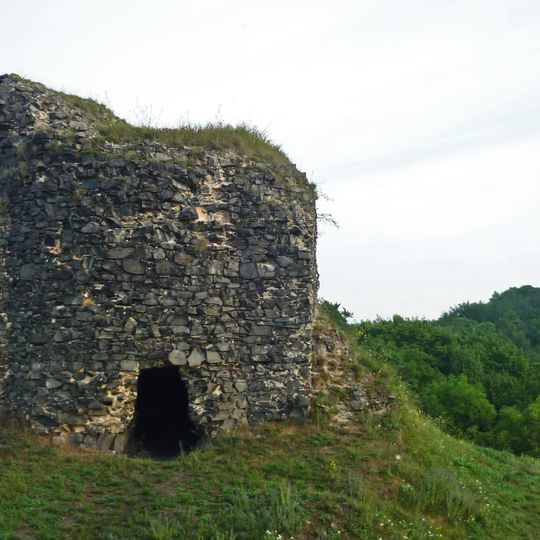
Ostrý Castle, Gothic castle ruin in Františkov nad Ploučnicí, Czech Republic.
Ostrý Castle, originally called Šarfenštejn (Scharfenstein), is a medieval ruin on a narrow basalt ridge at 250 m, encircled on three sides by the Ploučnice. Its pentagonal core has a later-built bergfrit at its head, while the palace opposite did not survive; only parts of the outer walls and the tower remain.
The Markvartici built the castle around 1230 on royal land; a 1268 seal names Marquardus de Sarfnstain. In 1283 Wenceslas II gave it to Jan of Michalovice, whose line held it until 1406. In 1445 the Lusatian Six Cities besieged it for four days, took and burned it; by 1515 it was recorded as deserted.
The castle's original name was Šarfenštejn, from the German Scharfenstein; Czech speakers now call it Ostrý. The ruin has been protected as a cultural monument since 1966. Visitors can still trace the pentagonal ground plan of the core and the bergfrit built into its front.
The ruin is freely accessible. A green-marked trail leads about 2 km from the centre of Benešov nad Ploučnicí, or 1.5 km from the railway station in Františkov nad Ploučnicí. The approach follows the western side of the narrow basalt ridge.
The castle's original name was Šarfenštejn, from the German Scharfenstein; the Czech name Ostrý came into use later. The narrow basalt ridge on which it stands is encircled on three sides by the Ploučnice, at 250 metres above sea level.
The community of curious travelers
AroundUs brings together thousands of curated places, local tips, and hidden gems, enriched daily by 93,679 contributors worldwide.