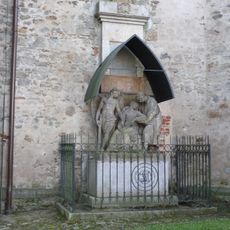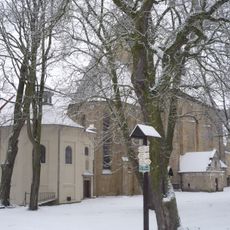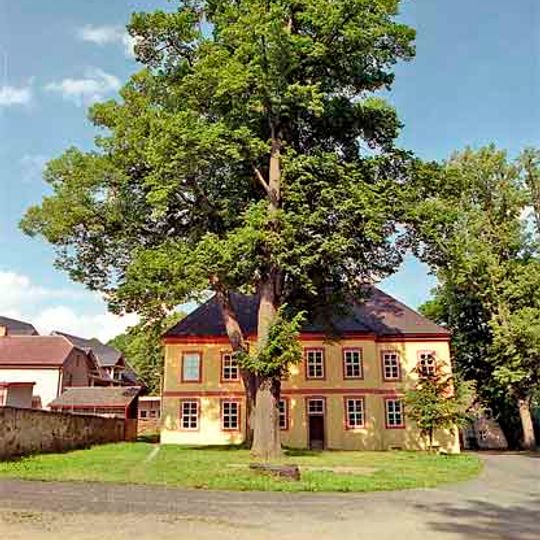
Pohled Castle, Baroque castle in Pohled, Czech Republic
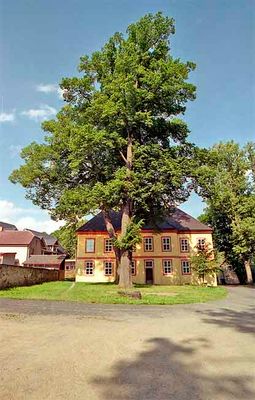
Pohled Castle is a one-storey, four-winged building on an H-shaped plan, rebuilt in classicist style from an early baroque convent. It encloses a former monastic cloister garth, with walled-up arcades on the ground floor and a monumental staircase leading to the upper floor. The adjoining late baroque prelature has a volute gable with stucco decoration.
Founded as a Cistercian convent, the Valley of the Blessed Virgin Mary, between 1265 and 1267 by the sisters Uta, Ludmila and Catherine, it was confirmed by Přemysl Otakar II in 1269. Plundered by Hussite troops in 1422 and 1424, rebuilt in the Baroque style between 1652 and 1690, it was dissolved on 20 March 1782 under Joseph II's reforms and rebuilt as a castle.
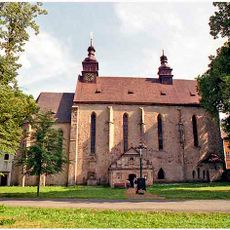
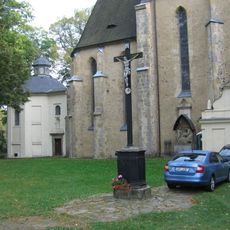
The monastery was called Údolí blahoslavené Panny Marie (Vallis beatae Virginis), shortened in Czech to Frántal, a name still used for the castle. Its church, now dedicated to St Andrew, was originally the monastery church of the Assumption. The village church already existed before the monastery was founded.
The castle stands on the right bank of the Sázava, with the Gothic church of St Andrew adjoining the west wing and the former prelature beside it. The grounds also hold a separate provost's house, stables and a granary, so allow time to walk the whole complex.
The four wings enclose a walled paradise courtyard from the former convent, with arcades now bricked up on the ground floor. A monumental staircase leads to the upper floor. The H-shaped plan preserves the monastic cloister layout beneath the classicist alterations.
The community of curious travelers
AroundUs brings together thousands of curated places, local tips, and hidden gems, enriched daily by 92,647 contributors worldwide.