Louka monastery, Medieval monastery in Znojmo, Czech Republic
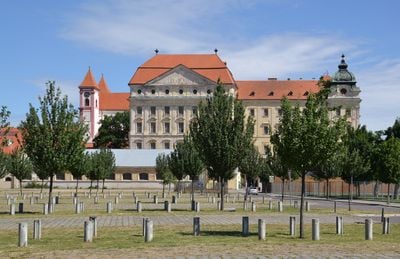
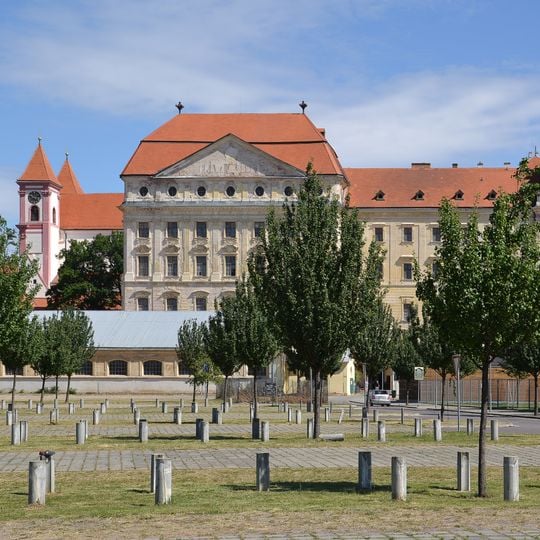
Louka Monastery is a former Premonstratensian abbey in the Louka district of Znojmo. Its cream-coloured facade has a three-storey central section with a triangular pediment and a red tile roof, round windows above rectangular ones, a white clock tower with a red pyramidal roof on the left and a long wing on the right. The complex was never completed.
Founded on 25 October 1190 by Duke Conrad Otto and his mother Maria, the monastery was ravaged by Hussite troops in 1425. Rebuilding in Gothic style began in 1440 under builder Niklas von Edelspitz and lasted until 1498. It was dissolved in 1784 under Josephinian reforms, after which the buildings served as a tobacco factory, military academy and barracks.
The monastery's name Louka means "meadow" in Czech, and its German name Klosterbruck refers to a bridge. The wine tradition continues under the Znovín Znojmo winery, which runs a visitor centre and wine museum in the former monastic buildings. The Church of St. Wenceslas holds the oldest surviving organ in Moravia.
The complex is open to visitors and offers guided tours through its various sections. It is best to wear comfortable shoes, as the paths through the buildings and old cellars can be uneven and there are multiple levels to navigate.
The monastery houses wine cellars with a long tradition of winemaking that remains in use by local producers today. These underground spaces reveal how medieval monasteries were not only religious centers but also economic and craft hubs.
The community of curious travelers
AroundUs brings together thousands of curated places, local tips, and hidden gems, enriched daily by 93,911 contributors worldwide.