Vlhošť, Mountain summit in Northern Bohemia, Czech Republic
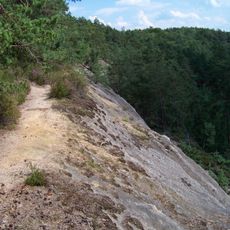
Wilschtberg is the highest summit of the Kokořínsko region at 614 m, a phonolite core that broke through the surrounding sandstone about 31 million years ago. Its slopes carry blocky sandstone terraces, and the whole hill is covered by forest, so views are limited to the rock terraces on the southwest side.
The mountain was first recorded in writing in 1406 as "in Wlhossti". In 1793 František Ambrož Reuss described its phonolite body and identified feldspar and amphibole crystals in it; his son August Emanuel Reuss later used the mountain in work on the stratigraphy of the Bohemian Cretaceous Basin. The summit and southwestern slopes became a nature reserve in 1998.
The name Vlhošť probably derives from the personal name Vělgost, meaning "Vlhost's hill"; a less likely reading links it to Velhošť or Velehošť, and the first element may come from the Germanic wild/wilth, "wild". The summit itself is forested and has no marked trail to the top; a yellow-marked path leads around it.
The trails leading to the summit are clearly marked and start from parking areas nearby. Visitors should wear sturdy footwear and be prepared for changing trail conditions depending on the season.
The summit core is phonolite that intruded the surrounding sandstone about 31 million years ago; geologist Franz Hantschel took it for a laccolith and argued about it with Hermann V. Graber, who called Vlhošť a phonolite dome.
The community of curious travelers
AroundUs brings together thousands of curated places, local tips, and hidden gems, enriched daily by 92,144 contributors worldwide.