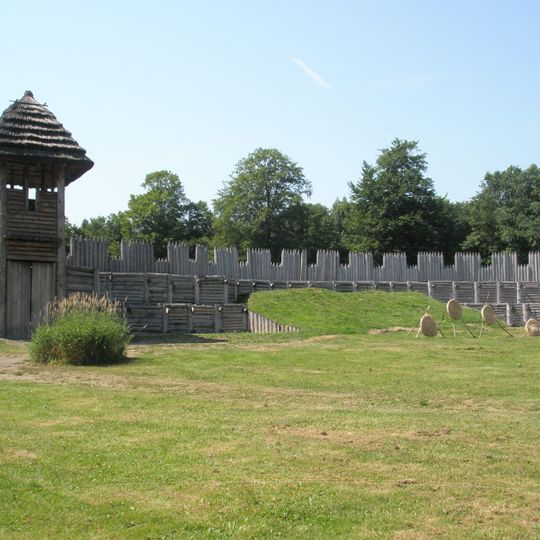
Archeopark in Chotěbuz, Archaeological site and hillfort in Podobora, Czech Republic.
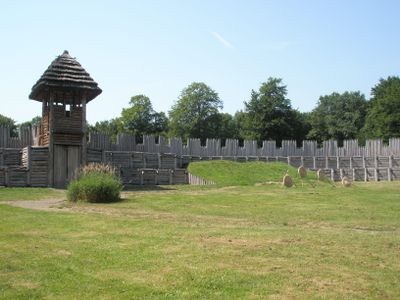
Starý Těšín, known in Polish as Stary Cieszyn, is a hillfort of the Slavic Holasice tribe on a small steep hill above the left bank of the Olza in Podobora, part of Chotěbuz. Since 2012 the site has been open as the Chotěbuz-Podobora Archaeopark, with a reconstructed hillfort built using UNESCO funds.
The hillfort was built by the Slavic Golensizi tribe, probably in the 7th century, on a hill above the left bank of the Olza, whose course then differed from today's. In the 9th century it was badly damaged, likely by the army of Great Moravian prince Svatopluk I or in wars between Moravians and Vistulans. Rebuilt alongside the new hillfort at Těšín's Zámecký vrch, it served as an administrative, religious and economic centre until it was abandoned around the turn of the 11th and 12th centuries.
The site displays everyday items and pottery that show how early Slavic people worked and lived together in this settlement. These objects reveal the skills and relationships that shaped their daily lives.
The site has an entrance building with interactive exhibitions and offers guided tours and educational programs for different ages. Wear comfortable shoes since you will be walking uphill to see the reconstructed structures and archaeological areas.
The site has been under archaeological protection since 3 May 1958. Finds show occupation reaching back to the Hallstatt period, roughly 800–750 BC to 500 BC, long before the Slavic hillfort was built.
The community of curious travelers
AroundUs brings together thousands of curated places, local tips, and hidden gems, enriched daily by 92,144 contributors worldwide.