Brno Crematorium, Functionalist crematorium in Štýřice, Czech Republic.
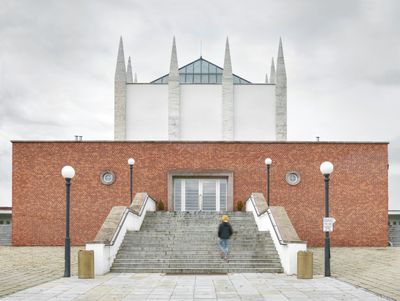
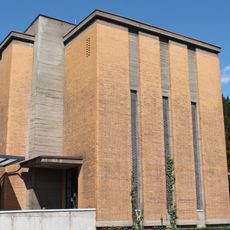
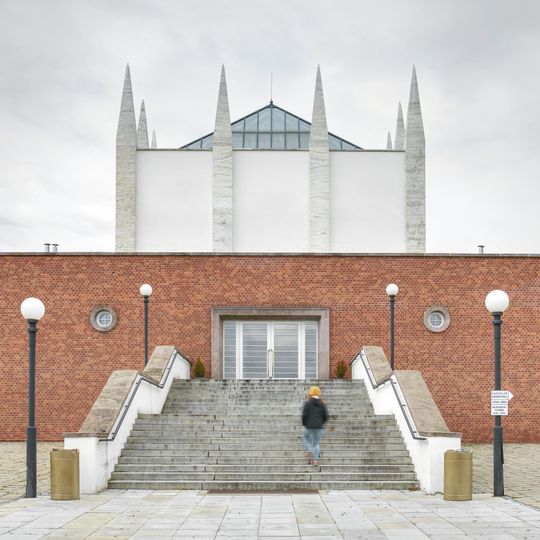
The Brno Crematorium is a funeral hall with a crematorium on the Central Cemetery in Štýřice, built in 1926–1929 to Arnošt Wiesner's design. Its white ceremonial building, ringed by travertine pillars, rises from a red horizontal base linked to the ground by a broad staircase; instead of a hall, Wiesner made an enclosed courtyard lit from a glazed ceiling.
Calls for a funeral hall with crematorium in Brno began in the early 20th century; a branch of the Vienna association Die Flamme was founded in 1911 and the Krematorium association in 1921. After cremation was legalised in 1919, a 1925 architectural competition was won by Arnošt Wiesner, and the building was erected in 1926–1929. The first funeral ceremony and first cremation took place on 8 April 1930.
The building is the only sacred work by architect Arnošt Wiesner, who sought an expression to rival the Egyptian pyramid and the Christian church. The white ceremonial block ringed by travertine pillars reads as a coffin surrounded by mourners, set on a red horizontal base reached by a broad staircase.
The crematorium stands on Jihlavská Street at the southern edge of Brno-střed, on the elevated ground above the Ústřední hřbitov (Central Cemetery), in the Štýřice cadastral area. Visitors approach from the cemetery side, where a massive staircase leads up to the red horizontal base of the funeral building. The site remained in full operation during its 13-month reconstruction, completed in September 2025.
The white ceremonial block is ringed by travertine pillars and rests on a red horizontal base linked to the ground by a massive staircase; Wiesner read the white body as a coffin surrounded by mourners. Instead of a hall he made a closed courtyard lit from a glazed ceiling, with a chimney rising behind the cremation space.
The community of curious travelers
AroundUs brings together thousands of curated places, local tips, and hidden gems, enriched daily by 92,394 contributors worldwide.