Płyta Środkowoczeska, Geomorphological region in Central Czech Republic.
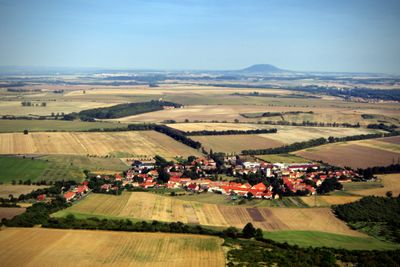
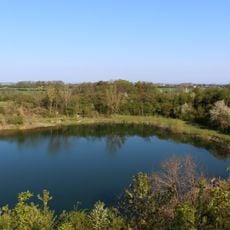
The Płyta Środkowoczeska is a geological region in the Czech Republic made up of sandstone, mudstone, and claystone layers from the Upper Cretaceous period. Rolling terrain here connects to walking routes that pass through varied landscapes.
The area is a structural step of the Czech Cretaceous Basin, built of subhorizontally bedded marlstones and sandstones laid down in the Upper Cretaceous sea. Neotectonic faulting later disturbed its margins, and the Labe, whose course shifted repeatedly during the Quaternary, cut the present relief. Its highest point is Říp (461 m).
The name Říp for the area's highest hill, 459 m, is tied to the legendary mountain where the mythical forefather Čech is said to have settled; the hill rises above the surrounding flat plateau and is a destination for national commemorations. The tabule's name refers to the flat, table-like surfaces formed on the Cretaceous sediments.
The area spans parts of the Středočeský, Ústecký, Pardubický, Královéhradecký, Liberecký, Vysočina and Prague regions, so it is reached by several separate road and rail corridors rather than one entry point. Its highest ground is Říp at 461 m, a low hill; the plateaus and river valleys along the Labe, Jizera and Ohře are the main orientation lines.
The area's highest point, Říp, is listed at 461 m in Czech sources and 459 m in Polish ones, a hill of the Řípská tabule subunit. The lowest named summit is Mrchový kopec at 211 m in the Terezínská kotlina. Tertiary basalts and their tuffs occur locally among the Cretaceous sediments.
The community of curious travelers
AroundUs brings together thousands of curated places, local tips, and hidden gems, enriched daily by 95,021 contributors worldwide.