Bílá skála, Natural monument in Libeň, Czech Republic
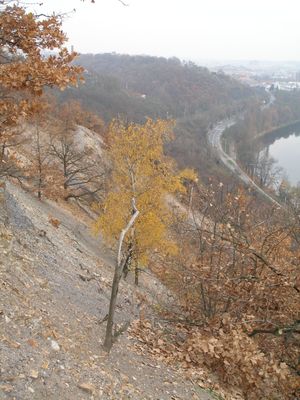
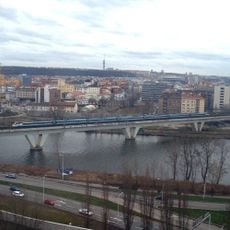
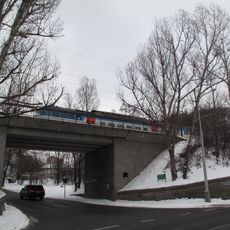
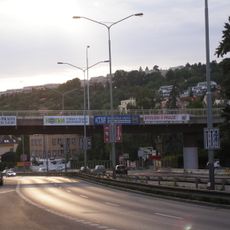
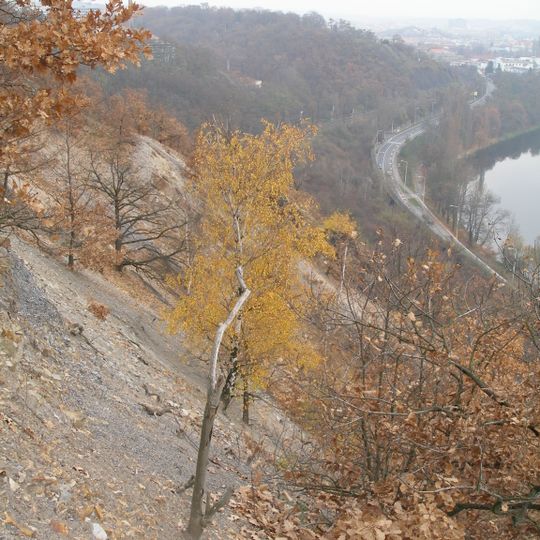
Bílá skála is a 7.65-hectare natural monument on the right bank of the Vltava in Libeň, made up of two south-facing rocky spurs, Bílá skála and Koráb, separated by Bulovka street. Its rocks are black shale, quartzite, sandstone and claystone, and an abandoned quarry filled with scree lies in the middle of the site.
Vineyards covered the area on Müller's 1720 map of Bohemia, and by the Second Military Survey of the early 19th century vines remained only on the slopes of Koráb. In the 19th century Manin artillerymen used Bílá skála as a target for practice fire. Quarrying at the south wall quarry ended around 1909, and the site was declared a natural monument by Prague decree 5/1988 on 4 July 1988.
The name comes from Eduard Štorch's novel Lovci mamutů, which sets the camp of the Mammoth Hunters' band on this spur above the Vltava. The upper edge of the cliff is used by the Hell.cz salon, which suspends people on hooks and ropes from the trees there.
The area is hard to reach because of dense vegetation and is overlooked by tourists; it has no marked hiking trails, no state-emblem signs and no information boards. Cyclist routes run along its southern edge, by Povltavská street on the right bank of the Vltava. The terrain rises from 184 to 258 m above sea level.
The name comes not from the rock's colour but from Eduard Štorch's novel Lovci mamutů, set here: in its final part the Mamutík hunting band camps on this Vltava spur. Psychotronic Pavel Kozák later placed a four-metre energy vortex in a three-stemmed bush on the western edge.
The community of curious travelers
AroundUs brings together thousands of curated places, local tips, and hidden gems, enriched daily by 92,355 contributors worldwide.