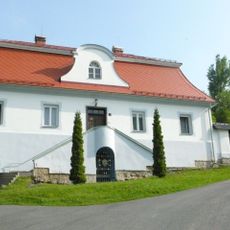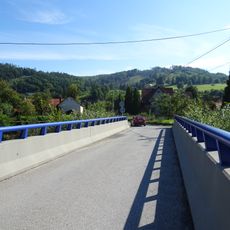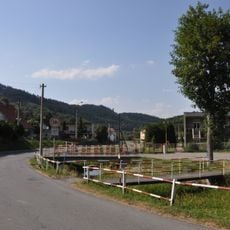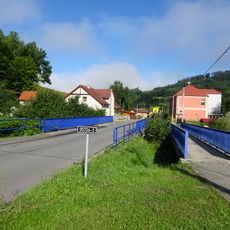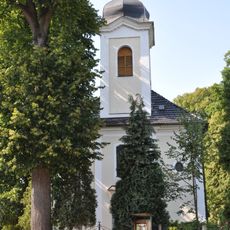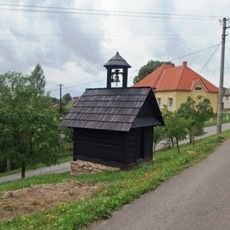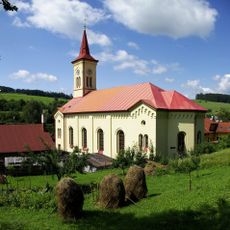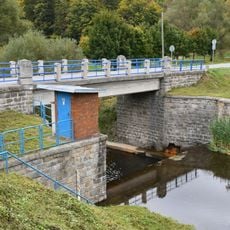
Bystřička Reservoir, Cultural monument and reservoir in Bystřička, Czech Republic.
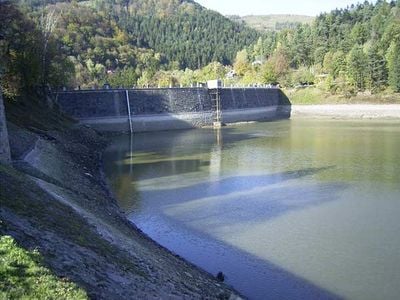
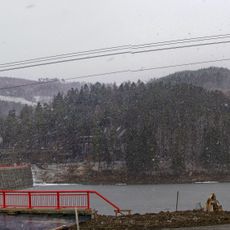
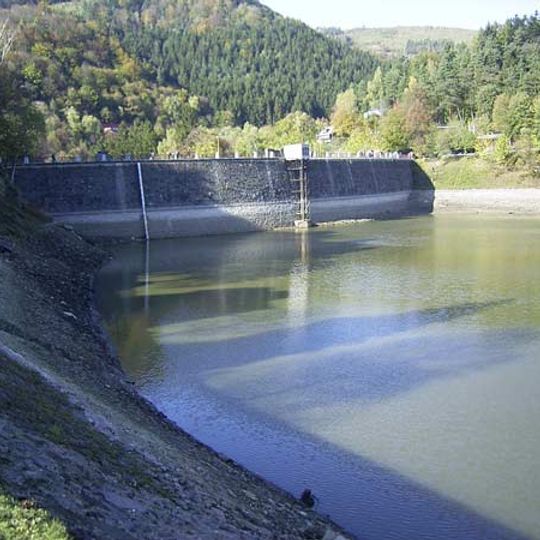
Bystřička Reservoir is a valley reservoir on the Bystřička stream in wooded hills about 7 km southeast of Valašské Meziříčí. Its gravity dam is built of rubble sandstone and Moravian greywacke masonry on a plain concrete base, stands 37.4 m high and runs 170 m across in a 135 m radius arc. The reservoir covers 38 ha and reaches about 26 m deep at the dam.
Bystřička Reservoir was built between 1907 and 1912 to supply water for a planned Danube–Oder–Elbe canal that was never realised; flood protection was a secondary aim. The design came from Vienna engineer Emil Grohman with architect Brangem, and the firm Rabas, Kosina a Weiner carried out the work. The dam and reservoir were listed as a cultural monument of the Czech Republic in 2003.
In the interwar years the shores were promoted as the Ľetovisko Bystřička resort, and after World War II, especially in the 1970s and 1980s, recreation became the reservoir's main role. Today two beaches, a boat and pedal-boat rental and an autocamping sit mainly in the bay on the north shore below Velká Lhota; motor boats are banned and sport fishing is allowed.
Public roads allow driving around the reservoir, and the dam crown is a 4.6 m wide walkway for pedestrians. Swimming is possible at two beaches, mainly in the bay on the north shore below Velká Lhota, where boats and pedal boats are rented. Motorized craft are banned; the water is open to sport fishing.
The dam's crown forms an arc with a radius of 135 metres and is 4.6 metres wide, serving as a footpath. The reservoir was the first dam built in the Morava river basin above its confluence with the Dyje.
The community of curious travelers
AroundUs brings together thousands of curated places, local tips, and hidden gems, enriched daily by 92,254 contributors worldwide.