Koloděje chateau, Baroque chateau in Koloděje, Czech Republic.
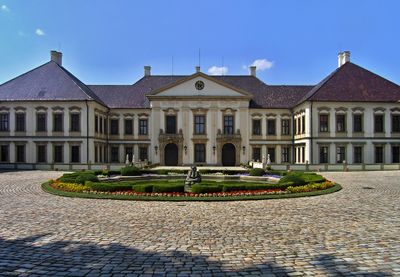
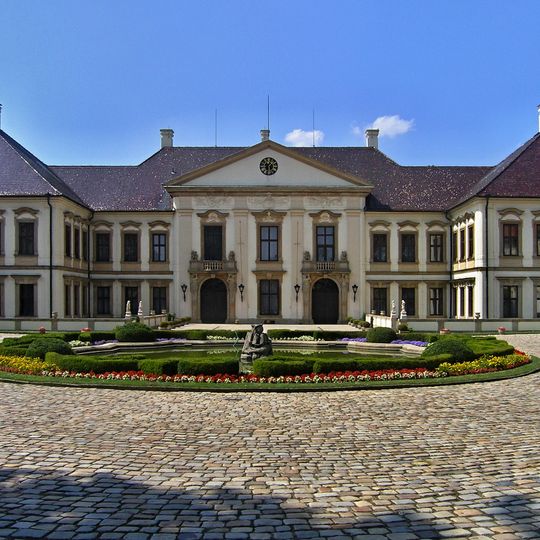
Koloděje chateau is a three-winged Baroque building on a horseshoe plan, rebuilt in 1706–1712 to designs attributed to Domenico Martinelli, with interiors decorated by the Viennese stuccoist Santini Bussi. Its cream facade has a projecting central section with a triangular pediment and clock, pilaster-framed bays, arched doorways with balconies, and flanking wings with rows of windows and dormers above a stone plinth.
The oldest surviving mention of a fortress at Koloděje dates from 1346; it guarded the road from Prague to Moravia. In the second half of the 16th century it was rebuilt as a Renaissance chateau, keeping its tall round tower. Jan Adam Ondřej of Liechtenstein had it rebuilt in high Baroque style in 1706–1712, probably by Domenico Martinelli.
The chateau's name comes from koloděj, an old Czech word for a wheelwright, and the village grew around the fortress guarding the Prague–Moravia road. In the 1950s the State Security fitted out a prison in the underground rooms, where Gustáv Husák, Vlado Clementis, Marie Švermová and Artur London were held.
The chateau is not open to visitors: it was returned by restitution to Vítězslav Kumpera, heir of Antonín Kumpera, at the end of 2008, and serves as a private residence. The cream facade, clock pediment and cobbled forecourt can be seen from the surrounding lanes.
The chateau's underground spaces held a prison of the State Security in the 1950s, where Gustáv Husák, Vlado Clementis, Marie Švermová and Artur London were among those detained. The building later hosted government sessions, including three Czech cabinet meetings in 2006 and 2007.
The community of curious travelers
AroundUs brings together thousands of curated places, local tips, and hidden gems, enriched daily by 92,197 contributors worldwide.