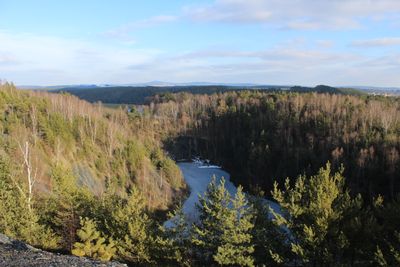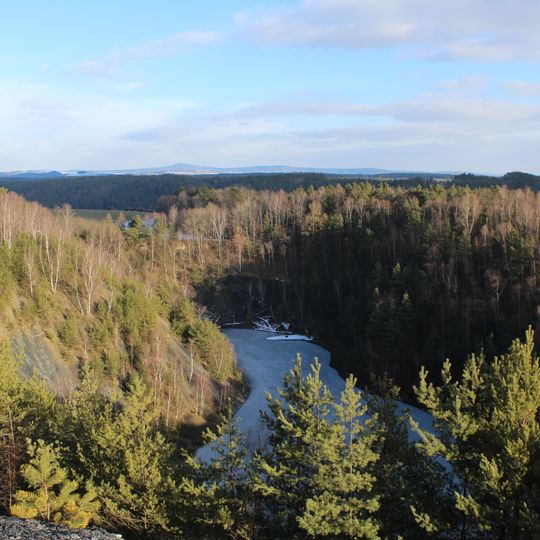
Hromnické jezírko, Natural monument near Hromnice, Czech Republic.
Hromnické jezírko is a protected lake near Hromnice in the Plzeň-North District with mixed water environments and natural vegetation around its edges. The site covers an area of wetland and open water where different plant and animal species live together.
Shale was mined here from the Middle Ages, and from 1807 Johann David Starck produced fuming sulfuric acid (oleum) from it, supplying the English and German dye industry. Mining ended in 1896, and shortly afterwards the drainage adit collapsed, flooding the pit to form the lake. In 1975 the lake and its surroundings were declared a natural monument on 12.2 ha.
The name Červené jezírko, "Red Lake", comes from iron compounds that tint the sulphuric-acid water red. From the Middle Ages the local shale was worked for alum, used as a bleach in textile production, and from 1807 for fuming sulphuric acid, oleum.
You can reach the site by following marked trails from the village of Hromnice at any time during daylight hours. The early morning is best for observing wildlife and plants without disturbing the natural environment.
The lake supports specialized mosquito larvae species that thrive only in specific water conditions found here. This makes the site valuable for researchers studying how insects adapt to unusual environments.
The community of curious travelers
AroundUs brings together thousands of curated places, local tips, and hidden gems, enriched daily by 92,372 contributors worldwide.