Gutštejn Castle, Castle ruin in Okrouhlé Hradiště, Czech Republic
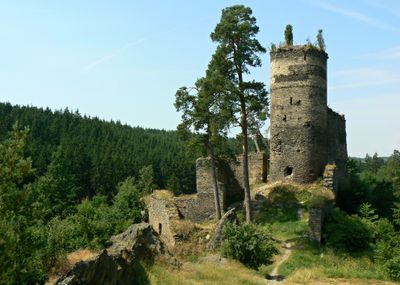
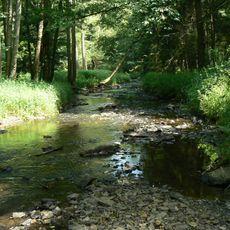
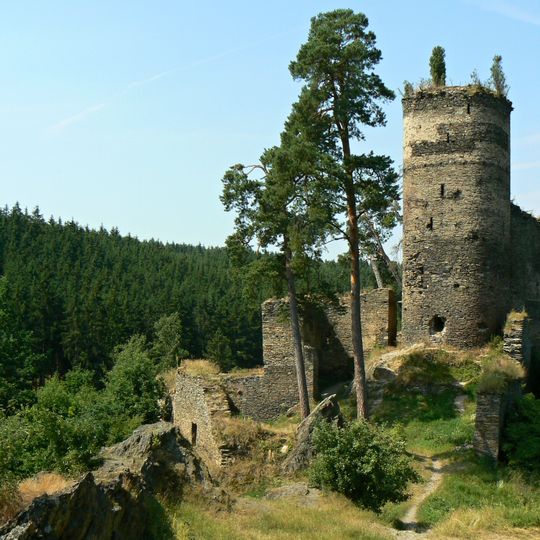
Gutštejn Castle is a ruin on a rocky spur above the Hadovka stream southeast of Konstantinovy Lázně. Its core is dominated by a square bergfried with rounded corners, entered via a portal reached by a drawbridge from the adjacent building or parapet wall. The south palace retains a barrel-vaulted cellar, and the site is a protected cultural monument.
Gutštejn was founded around 1300, probably by Jetřich of the Hroznatovci, and first appears indirectly in a 1319 deed when the Teplá abbot leased three villages to him and his son Sezema. During the Hussite wars Jan Žižka's army besieged the castle, whose lords sided with the Catholic nobility. Viktorin sold it in 1549 to Hanuš Elpognar, who attached it to the Bezdružice estate; it was abandoned during the Thirty Years' War.
The castle gave its name to the lords of Gutštejn, a Catholic noble family whose members held high offices in the Kingdom of Bohemia. Burian the Rich served as Oberstkämmerer from 1472 and chancellor of the Grünberg Alliance from 1485. Four sets of stove tiles from the 15th and 16th centuries were found here, the oldest probably ordered by Burian II.
The site is open year-round and visitors can explore the ruins along marked paths. Wear sturdy shoes since the ground is uneven and some walls may be unstable.
Archaeological digs at the castle uncovered four sets of stove tiles from the second half of the 15th to the second half of the 16th century. The oldest set was probably ordered by Burian II of Gutštejn, though its Hussite motif sits oddly with his known Catholicism. A fourth set, found in the lower courtyard building, shows the castle was still in use after 1549.
The community of curious travelers
AroundUs brings together thousands of curated places, local tips, and hidden gems, enriched daily by 92,205 contributors worldwide.