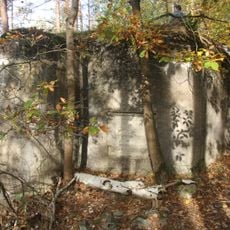
Vrškamýk Castle, Medieval castle ruin in Kamýk nad Vltavou, Czech Republic.
Vrškamýk Castle is a two-part ruin on a narrow ridge at 345 metres, one kilometre west of Kamýk nad Vltavou. The front section had a long building and a square gate tower with a cross-vaulted passage; a broad ditch separates it from the rear castle, where three palace wings around a courtyard survive as courtyard walls and partition fragments.
A Přemyslid watch and hunting castle probably stood here from the late 10th century; the first written record is from 16 June 1186, when Duke Frederick issued a donation charter for Zwettl Abbey at Vrškamýk. Wenceslas I rebuilt it as a royal castle and made it in 1236 the administrative and judicial seat for the left-bank Vltava part of the Bozeň district; Přemysl Otakar II completed it. Archaeology dates its abandonment to shortly after 1306, after static faults in the rear castle's outer wall; in 1569 it was called deserted.
The ruin is also called Hunec after a legendary knight who administered Vrškamýk and was notorious for cruelty to his subjects. During a hunt near Zduchovice he was ambushed, robbed and killed in the Jezerná forest. The castle's Czech name Vrškamýk is sometimes wrongly replaced by Hunec.
The ruin is reached on foot along the green-marked hiking trail from Kamýk nad Vltavou to Zduchovice; the ridge path is uneven in places, so wear sturdy shoes. East of the castle, on the same trail, stand a playground and an observation tower built during the 2009–2010 restoration.
The castle was long overlooked, but today it ranks among the most important buildings of the last Přemyslids. Its design, with extremely long and narrow side wings, resembles the slightly later Bezděz Castle. The ruin has been protected as a cultural monument since 1958.
The community of curious travelers
AroundUs brings together thousands of curated places, local tips, and hidden gems, enriched daily by 92,601 contributors worldwide.