Cubist Kiosk, Cultural monument kiosk in New Town, Prague, Czech Republic
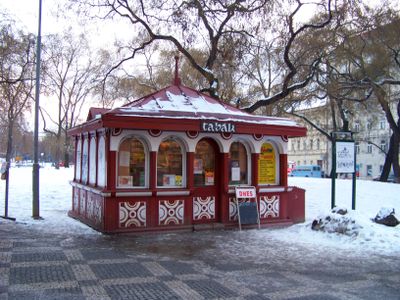
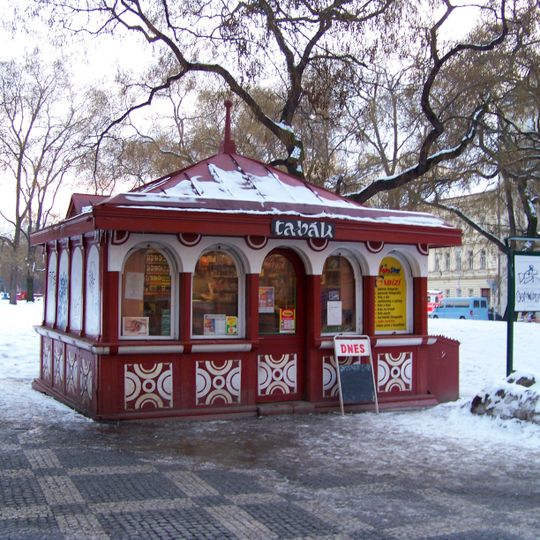
The Cubist Kiosk is a wooden tobacco and newspaper stand in Vrchlického sady, near Bolzanova Street and the path to Prague's main railway station. Built in the 1920s in the rondocubist style, it is a small single-storey booth whose design is attributed to architect Pavel Janák.
The wooden tobacco and newspaper kiosk dates from the 1920s and is attributed to architect Pavel Janák, though Norbert Kiesling's 2011 monograph on Janák omits it because it appears in none of the architect's own lists of works. Scheduled for demolition in 1980, it was saved by the Prague Centre for State Heritage Care, declared a cultural monument in 1981 and restored; Prague 1 paid 165,000 CZK for repainting in 2008.
The kiosk was built as a tobacco and newspaper stand, and in November 2017 it was operating as a currency exchange office, a use the Prague 1 district council rejected by resolution and prepared legal steps against. Unauthorised ATMs were later installed, damaging the structure.
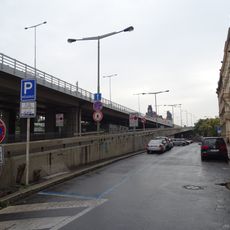
The kiosk stands in Bolzanova Street, at the edge of Vrchlického sady on the path toward Hlavní nádraží and the corner with Opletalova Street. It is a small wooden structure, so it is seen from outside in passing; the surrounding park and the main station are within a short walk.
The kiosk is probably the only surviving structure of its kind. Its design and period match Josef Gočár's wooden houses built for the Kbely airport, which places the kiosk in the same rondocubist current as those buildings.
The community of curious travelers
AroundUs brings together thousands of curated places, local tips, and hidden gems, enriched daily by 92,158 contributors worldwide.