Kunin Castle, Baroque château in Kunín, Czech Republic.
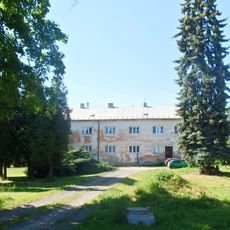
Kunín Castle is a two-storey Baroque building on a rectangular plan with a mansard roof, rebuilt from an older single-storey structure to Johann Lucas von Hildebrandt's design. Its pilastered main façade faces the park, topped by an attic with balustrade and statues, and a carved gable bears the arms of the Harrach and Liechtenstein families. A covered wooden walkway links the second floor to the neighbouring Church of the Exaltation of the Holy Cross.
Bedřich August of Harrach-Rohrau and his wife Eleonora of Liechtenstein had an older single-storey building rebuilt between 1726 and 1734 to plans by Johann Lucas von Hildebrandt, as a retreat rather than a residence. Their granddaughter Marie Walburga of Waldburg-Zeil turned it into a Philanthropinum, where František Palacký studied. The Bauer family owned it until Viktor Bauer died there in 1939.
The castle's name in German, Kunwald, and its use as a summer seat recall the Harrach and Liechtenstein builders, whose coats of arms appear on the Baroque gable. Countess Marie Walburga ran a Philanthropinum here from 5 a.m. to 7 p.m., teaching gymnastics and swimming, the first such lessons in Moravia.
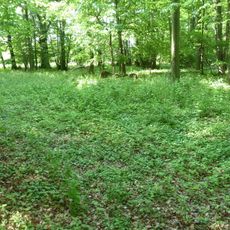
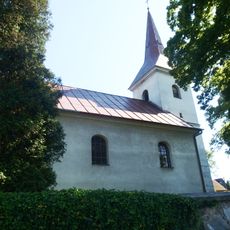
The castle stands in the centre of Kunín, in the Nový Jičín district of the Moravian-Silesian Region. A covered wooden walkway links the second floor to the neighbouring Church of the Exaltation of the Holy Cross, originally the castle chapel of 1758. The castle park, restored after 2000 to its late 19th-century English layout, holds a replica of a wooden skittle alley.
A covered wooden walkway links the castle's second floor directly to the neighbouring Church of the Exaltation of the Holy Cross, originally the castle chapel built in 1758. The building also has an unusual chimney system running through its two floors and mansard roof.
The community of curious travelers
AroundUs brings together thousands of curated places, local tips, and hidden gems, enriched daily by 92,160 contributors worldwide.