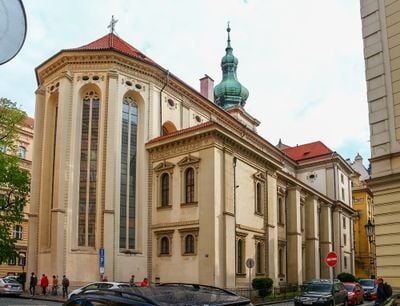
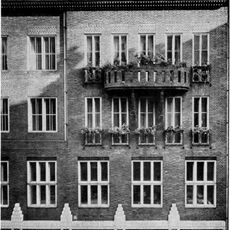
Church of the Holy Saviour, Renaissance church in Old Town, Prague, Czech Republic
The Church of the Holy Saviour is a post-Gothic basilica with galleries, built as a hall with a polygonal high choir closed in five sides of a decagon and tall traceried windows; the upper clerestory windows are occuli. Cross-ribbed vaults rest on pilasters with Corinthian capitals, and the grey vault carries the painted inscription "ANCILA DOMINI SIT MIHI SECUNDUM VERBUM TUUM".
The cornerstone was laid on 27 July 1611 for Prague's German Protestant congregation, on land bought by Joachim Andreas von Schlick in 1610; the church was consecrated in October 1614. After the Battle of the White Mountain it was confiscated and in 1624 handed to the Pauliners, who incorporated it into their monastery. The monastery was dissolved in 1796 and the church served as a mint until 1857; Prague Protestants bought it in 1863.
The name refers to the Saviour, Jesus Christ; the church was founded for Prague's German Protestant congregation. From 1624 it belonged to the Pauline order, whose monastery was dissolved in 1796, and since 1918 it has served the Evangelical Church of Czech Brethren. The painted vault text reads "ANCILA DOMINI SIT MIHI SECUNDUM VERBUM TUUM".
The church stands in Old Town between Salvátorská, Kostečná and Dušní streets, a short walk from Old Town Square. It is an active congregation of the Evangelical Church of Czech Brethren, so the interior is open around services; the exterior can be seen at any time from the surrounding lanes.
The organ on the gallery was installed in 2011 by Hermann Eule Orgelbau of Bautzen, using the 1865 case of Karel Vocelka's instrument; it has 37 registers on three manuals and pedal, plus a Zimbelstern and a Glockenspiel. Seven wooden-pipe registers come from the earlier organ.
The community of curious travelers
AroundUs brings together thousands of curated places, local tips, and hidden gems, enriched daily by 92,558 contributors worldwide.