Kamenná vila, Neo-Renaissance villa in Bílé Předměstí, Pardubice, Czech Republic
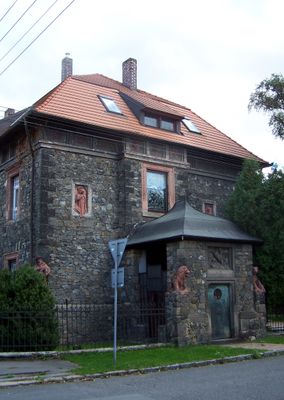
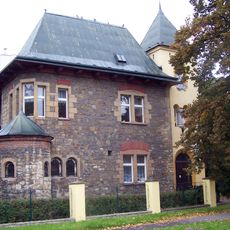
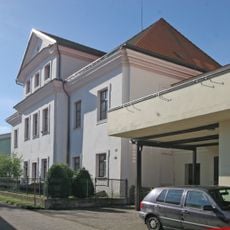
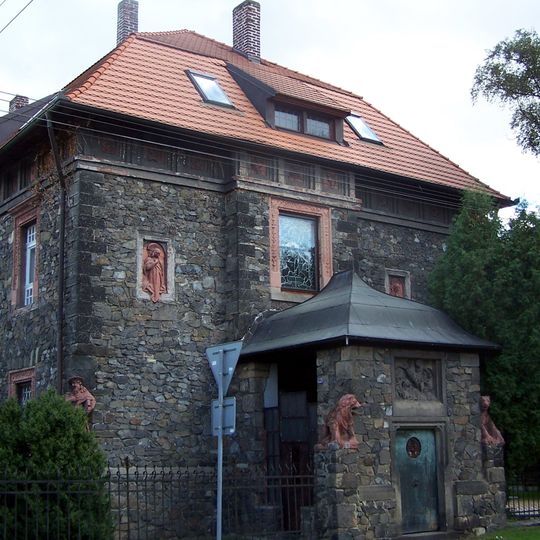
Kamenná vila is a three-storey Neo-Renaissance villa at house number 144, built 1913–1921 to a design by architect Bóža Dvořák. Its facade is laid in unrendered, neatly jointed quarry stone, topped by a stepped hipped roof and enriched with reliefs by Miloslav Baše, Dvořák's son-in-law.
Josef Doubrava, bishop of Hradec Králové, had the villa built between 1913 and 1921 to the design of architect Bóža Dvořák, probably to house his art collection. In 1958 it was declared a cultural monument under number 29491/6-4382, and in 1997 the building was converted into a corporate headquarters.
The villa's name comes from its façade of unrendered, paired quarry stone, which gives the building its characteristic rough surface. The sculptural and relief decoration was made by Miloslav Baše, the son-in-law of architect Bóža Dvořák. In the western façade, a coloured stained-glass Madonna with Child, designed by Mikoláš Aleš in 1912, can be seen.
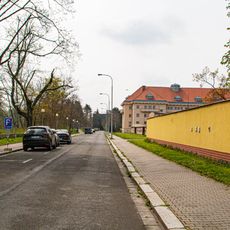
The villa stands at house number 144, at the corner of Bulharská Street and U Kamenné vily Street in Bílé Předměstí. It now serves as a corporate headquarters, so the interiors are not open to the public; the stone façade, reliefs and the Madonna stained glass on the western front can be viewed from the street.
The villa served as a filming location for Jiří Strach's three-part television film Ďáblova lest. Its interiors also feature stucco decoration and doors inlaid with intarsia, details a visitor can spot inside the building.
The community of curious travelers
AroundUs brings together thousands of curated places, local tips, and hidden gems, enriched daily by 92,375 contributors worldwide.