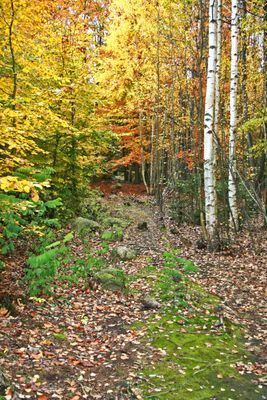
Kounovské kamenné řady, Ancient megalithic site near Kounov, Czech Republic
Kounovské kamenné řady consists of 14 roughly parallel rows of quartzite blocks, mostly 50–60 cm high, running almost exactly north–south across an 11-hectare plateau. The rows are spaced irregularly, 11 to 18 m apart, and vary in length from 50 to 350 m; the site is crossed by a forest path.
The site was discovered and first examined in 1934 by teacher Antonín Patejdl, bringing it to the attention of archaeologists and heritage officials. This finding led to its recognition and protection as an important monument.
The name of the largest block, Gibbon I, refers to the Golden Gibbon prize that the editors of the radio programme Meteor awarded in 1974 to the young researchers from Rokycany. In the inn U Tří lip in Kounov there is an exhibition on the stone rows.
A walking trail with information stations guides visitors across the site, starting near Mutějovice railway station. The path is accessible and covers about two kilometers, allowing you to explore all the rows.
Two particularly large stones at the site are named Gibbon and Pegasus and may have a connection to celestial bodies according to researchers. Their placement seems deliberate and invites you to wonder about the intentions of those who built it.
The community of curious travelers
AroundUs brings together thousands of curated places, local tips, and hidden gems, enriched daily by 92,137 contributors worldwide.