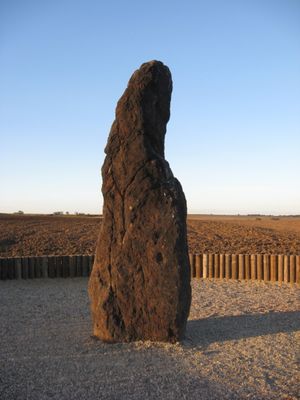
Kamenný pastýř, Prehistoric menhir in Klobuky, Czech Republic.
Kamenný pastýř is a solitary menhir standing in a field about one kilometre north-west of Klobuky. The unworked column of rusty-brown ferruginous Cretaceous sandstone rises some 340 cm above ground, with 70 cm buried, measures about one metre at its widest and weighs roughly five tonnes.
The menhir was first recorded on a map in 1841. In February 1852 a storm knocked it over, and the residents of Klobuky re-erected it with ceremony. In 1898 J. L. Píč had the ground excavated and showed that the stone had been set upright artificially in a sandy layer above the bedrock.
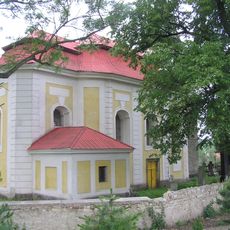
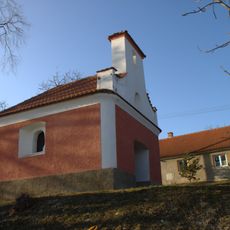
Local legend says the shepherd's flock strayed and he stood waiting until he turned to stone; another tale holds that with every bell rung in the Klobuky chapel he steps forward a grain of sand, and when he reaches it the world ends, though bells in Telce send him back. Modern Celts hang offerings on the stone and light fires at solstices.
The menhir stands alone in a field about one kilometre north-west of Klobuky, reached by an educational trail from Kokovice to Klobuky. Since 2007 the immediate surroundings have been paved and a path leads to the road, and visitors can sit on a low wooden palisade fence beside the stone.
Measurements conducted around the summer solstice have detected geomagnetic field anomalies in the immediate vicinity of the stone. This phenomenon remains relatively overlooked when compared to other aspects of the site.
The community of curious travelers
AroundUs brings together thousands of curated places, local tips, and hidden gems, enriched daily by 93,680 contributors worldwide.